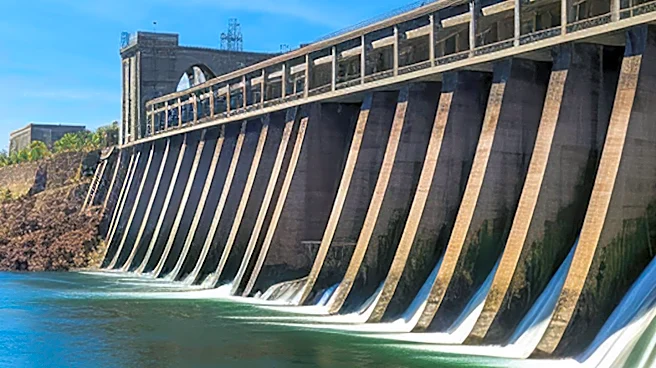







The Grand Coulee Dam stands as a significant concrete gravity dam on the Columbia River in Washington state. Its construction, spanning from 1933 to 1942, was driven by a dual purpose: to generate hydroelectric power and to supply irrigation water to the surrounding agricultural lands. This massive engineering feat has profoundly shaped the Pacific Northwest, becoming the largest power station in the United States by nameplate capacity and a vital
source of water for a vast agricultural region.
Early Development and Initial Capacity
When it was first completed in 1942, the Grand Coulee Dam was equipped with two powerhouses, designed to harness the immense power of the Columbia River. These initial facilities laid the groundwork for the dam's role in providing electricity to the region. The construction period itself was a monumental undertaking, reflecting the ambition and engineering prowess of the era, especially given the challenges of building such a large structure during the 1930s and early 1940s.
The dam's design as a concrete gravity dam means it relies on its sheer weight to resist the horizontal thrust of the water. This robust construction allowed it to create Lake Franklin D. Roosevelt, a vast reservoir that serves as a critical component of its operational capabilities. The lake not only stores water for power generation but also acts as the primary source for the dam's irrigation system, demonstrating the integrated nature of its functions from the outset.
Expanding Energy Production
Decades after its initial completion, the demand for energy continued to grow, leading to a significant expansion of the Grand Coulee Dam's power generation capabilities. In 1974, a third powerhouse, known as "Nat," was completed. This addition dramatically increased the dam's energy output, solidifying its status as a powerhouse in the national energy landscape.
With the completion of the third powerhouse, the Grand Coulee Dam achieved a nameplate capacity of 6,809 MW, making it the largest power station in the United States. This substantial capacity ensures that the dam continues to be a major contributor to the cheap electric power available across the Pacific Northwest, supporting industries and communities throughout the region. The continuous evolution of its power generation infrastructure highlights its enduring importance as an energy asset.
Irrigation and Agricultural Impact
Beyond its role in hydroelectric power, the Grand Coulee Dam is instrumental in providing irrigation water for agriculture in Central Washington. The water impounded by the dam, forming Lake Franklin D. Roosevelt, is channeled to irrigate approximately 2,700 square kilometers of farmland. This extensive irrigation system has transformed arid lands into productive agricultural areas.
The availability of reliable irrigation water has had a profound impact on the agricultural economy of Central Washington. It supports a diverse range of crops and contributes significantly to the region's food production. The dam's ability to manage water resources for both power and agriculture underscores its multifaceted utility and its central role in the economic and environmental landscape of the state.