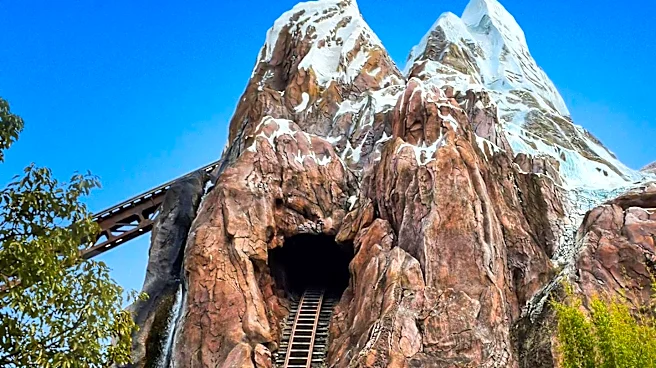







Big Thunder Mountain Railroad stands as a prominent mine train roller coaster across four Disney parks worldwide. Its journey from an initial concept to a globally recognized attraction involved significant design considerations, thematic adaptations, and technological advancements. The ride's development reflects Disney Imagineering's continuous effort to create immersive experiences, evolving from earlier attractions and incorporating new technologies
like computer-aided design.
Origins and Early Concepts
The genesis of Big Thunder Mountain Railroad can be traced back to the desire to replace an earlier attraction, Mine Train Through Nature's Wonderland, which operated in Frontierland at Disneyland from 1956 through 1977. The original design for Big Thunder Mountain was developed by Tony Baxter, a key Imagineer. This project was initially put on hold in 1974, as resources and personnel were redirected to construct Space Mountain in Tomorrowland. However, this delay proved beneficial, as it allowed for the incorporation of computer-aided design, a nascent technology at the time, which contributed to a smoother ride experience. Big Thunder Mountain Railroad was among the first Disney rides to utilize this advanced design method.Before Big Thunder Mountain, the area in Disneyland hosted Rainbow Caverns Mine Train, which opened in Frontierland about a year after Disneyland's debut in 1955. This attraction, and its successor Mine Train through Nature's Wonderland from 1960, featured a journey through an elaborately designed desert landscape known as the Living Desert. The theme of a living desert landscape was maintained, with scenery and backdrops adapted from attraction to attraction, alongside adjustments to the narratives. Many elements from these predecessors were either reused or incorporated into the new Big Thunder Mountain Railroad, paying tribute to its heritage. For instance, the fictional mining town of Rainbow Ridge, originally built in 1956 for Rainbow Caverns Mine Train, was reused and remains a fixed component of the attraction today, largely due to Tony Baxter's influence in planning and realizing the new coaster.
Global Expansion and Thematic Variations
Big Thunder Mountain Railroad first opened at Disneyland in 1979. A year later, a larger version debuted at Magic Kingdom in Florida in 1980. Tokyo Disneyland's version followed in 1987, and Disneyland Paris opened with its version in 1992. Notably, the Disneyland Paris installation was an opening-day attraction for its park, a unique distinction among the Big Thunder Mountain rides. While the ride layout at Magic Kingdom in Disney World is nearly identical to the one at Disneyland, each installation possesses unique characteristics.The thematic elements also vary by location. The rock work designs in the Disneyland version are based on the hoodoos of Bryce Canyon National Park in Utah, featuring more rounded features and muted colors. In contrast, the Magic Kingdom, Tokyo, and Paris versions draw inspiration from the rising buttes found in Arizona and Monument Valley in Utah, characterized by sharp-edged mountains and vibrant colors. The Florida version, for example, was allocated more space, resulting in a Monument Valley-inspired ride structure that is 2.5 acres, 25 percent larger than the Disneyland version. The design philosophy aimed to make it appear as if the rocks were naturally present, and the track was built around them, a reversal from earlier mine rides where rocks were sculpted around the tracks.
Refurbishments and Modernizations
Over the years, the Big Thunder Mountain Railroad attractions have undergone significant refurbishments to enhance the guest experience and maintain their operational integrity. The Disneyland version, for instance, closed on January 7, 2013, for an extensive refurbishment that included new track, trains, scenery, and updated effects on the third lift hill. It reopened on March 17, 2014. The new track was fabricated by Dynamic Structures, a company known for its work on other Disney coasters like Space Mountain.Similarly, the Paris version underwent a year-long refurbishment from November 2015 to December 2016. This renovation included overhauling the brakes, repainting some of the scenery, and adding elements from the California version, such as rainbow pools of water on the first lift hill cave, new sound effects for the mine elevator on the second lift hill, and new mapping effects for the blasting scene on the third lift hill. Interactive games were also installed in the queue line to entertain guests. The Magic Kingdom location is also slated for a year-long renovation beginning January 6, 2025, with a reopening planned for May 3, 2026. This refurbishment will update the opening scene, refresh Rainbow Caverns, and introduce new audio-animatronics and gold props. Additionally, the height limit for the ride will be lowered from 40 inches to 38 inches, and the original maintenance shed will be removed to accommodate new attractions.