







Gigabit Ethernet, often abbreviated as GbE or 1 GigE, represents a significant leap in computer networking, enabling the transmission of Ethernet frames at a rate of one gigabit per second. This technology has become the dominant force in wired local networks, largely superseding its predecessor, Fast Ethernet, due to its substantial speed improvements and compatibility with widely available and economical cabling. The technical underpinnings of Gigabit Ethernet are
defined by a series of IEEE standards, each addressing different physical media and transmission methods.
Key Standards and Cabling for Gigabit Ethernet
The initial standard for Gigabit Ethernet was IEEE 802.3z, produced in June 1998. This standard primarily mandated the use of optical fiber for transmission and is commonly known as 1000BASE-X. The 'X' in 1000BASE-X refers to various sub-standards such as -CX, -SX, -LX, or the non-standard -ZX, each specifying different fiber types and distances. For instance, 1000BASE-SX is designed for multi-mode fiber, while 1000BASE-LX is for single-mode fiber, offering longer reach. These fiber-based solutions were initially deployed in high-capacity backbone network links, such as within large campus networks.
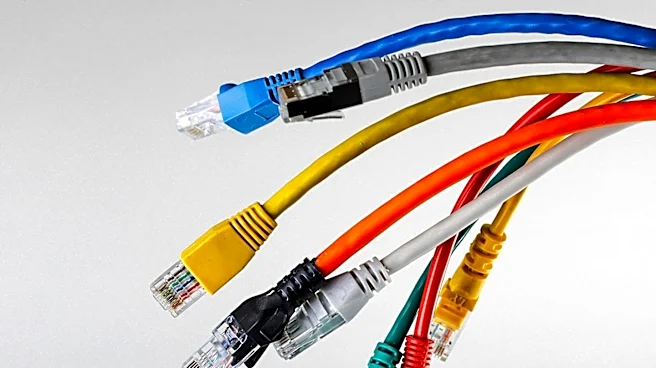
A pivotal development for Gigabit Ethernet's widespread adoption was the ratification of IEEE 802.3ab in 1999. This standard defined Gigabit Ethernet transmission over unshielded twisted pair (UTP) cabling, specifically Category 5, 5e, or 6, and became known as 1000BASE-T. The significance of 1000BASE-T was immense: it allowed organizations to utilize their existing copper cabling infrastructure, making Gigabit Ethernet a practical and economical "desktop technology." This variant quickly became the most popular, facilitating the replacement of Fast Ethernet in many environments. 1000BASE-T uses a distinct encoding scheme to maintain a low symbol rate, enabling transmission over twisted pair cables, which typically have a maximum recommended length of 100 meters.
Advanced Features and Fiber Optic Variants
Beyond the core 1000BASE-T standard, Gigabit Ethernet includes several advanced features and specialized fiber optic variants. Automatic MDI/MDI-X configuration, an optional feature in the 1000BASE-T standard, is commonly implemented. This feature allows network devices to automatically detect and adjust for straight-through or crossover cables, eliminating the need for manual cable selection and reducing wiring errors. Autonegotiation is a mandatory requirement for 1000BASE-T, as it facilitates the negotiation of the clock source for the link, determining which endpoint acts as master and which as slave.
For fiber optic implementations, the IEEE 802.3z standard includes 1000BASE-SX for multi-mode fiber and 1000BASE-LX for single-mode fiber. These standards use 8b/10b encoding, which adds a 25% overhead to ensure a DC balanced signal and allow for clock recovery. In 2004, IEEE 802.3ah further expanded GbE fiber standards by adding 1000BASE-LX10 and 1000BASE-BX10, which were part of the broader "Ethernet in the first mile" group of protocols. 1000BASE-LX10, for example, achieves distances up to 10 km over single-mode fiber. Non-standard but industry-accepted terms like 1000BASE-EX and 1000BASE-ZX refer to even longer-reach variants, capable of distances up to 40 km and 70 km (or more) over single-mode fiber, respectively, often using different wavelengths.
Specialized Implementations and Future Directions
Gigabit Ethernet has also seen specialized implementations for specific applications. For instance, IEEE 802.3 standardized 1000BASE-T1 in 2016, defining Gigabit Ethernet over a single twisted pair for automotive and industrial uses, with cable specifications for reaches of 15 or 40 meters. Another variant, 1000BASE-KX, was standardized as part of IEEE 802.3ap-2007 for Ethernet Operation over Electrical Backplanes, using a 1.25 GBd electrical signaling speed. While half-duplex GbE links connected through repeater hubs were part of the IEEE specification, full-duplex operation with switches is now exclusively used in practice.
The continuous drive for higher speeds has led to newer standards like 2.5GBASE-T and 5GBASE-T. These operate at 2.5 and 5.0 Gbit/s, respectively, over existing copper infrastructure designed for 1000BASE-T. They are based on 10GBASE-T but employ lower signaling frequencies to maximize the use of current Cat-5e and Cat-6 cabling. This ongoing innovation ensures that Gigabit Ethernet and its successors continue to meet the evolving demands of modern networking, providing faster, more reliable, and more versatile connectivity solutions.