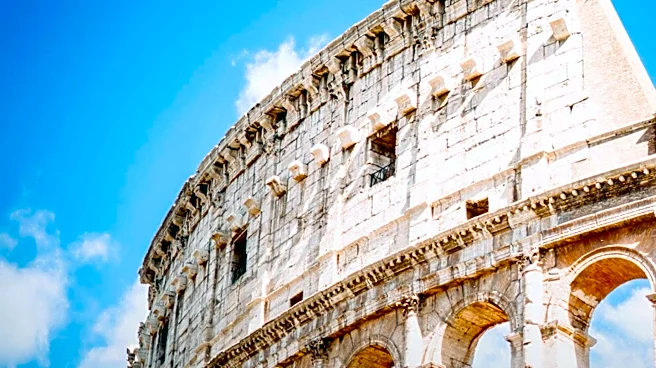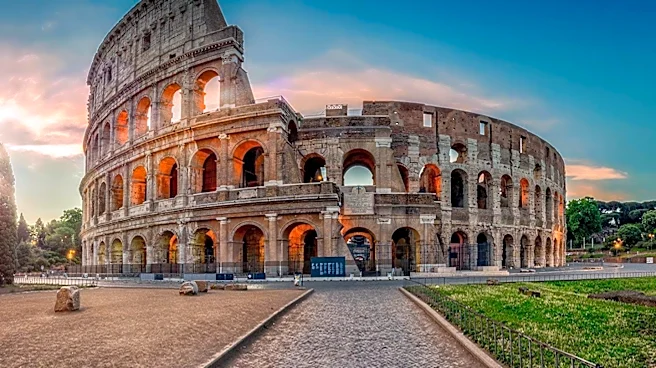



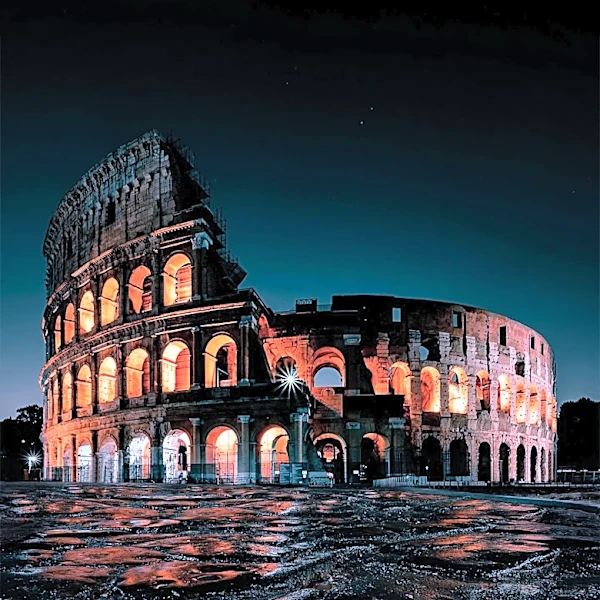



The Colosseum, originally known as the Flavian Amphitheater, represents a monumental achievement of the Flavian dynasty, a period of Roman imperial rule that began with Emperor Vespasian. Its construction was not merely an architectural endeavor but a politically charged project aimed at restoring public favor and asserting imperial power after the tumultuous reign of Nero. The decision to build such a colossal structure in the heart of Rome, on land
previously appropriated by Nero, was a deliberate populist gesture, returning a significant area of the city to its people. This article delves into the origins of this grand project, its funding, and the immense human effort required to bring it to fruition.
Imperial Patronage and Political Context
Construction of the Colosseum commenced under Emperor Vespasian, who reigned from 69 to 79 AD, with work beginning around 70-72 AD. The project was completed by his son and successor, Titus, in 80 AD, and further modifications were made during the reign of Domitian, Vespasian's younger son. These three emperors, known as the Flavian dynasty, were the primary patrons of this massive undertaking, which is why the amphitheater was later named the Flavian Amphitheater by classicists and archaeologists. Vespasian's choice of location for the Colosseum was highly symbolic. It was built on a flat area in a low valley between the Caelian, Esquiline, and Palatine Hills, specifically on the site of Nero's artificial lake, which was part of his grandiose Domus Aurea complex. By filling in the lake and constructing a public amphitheater, Vespasian effectively reclaimed and democratized an area that Nero had privatized for his own lavish use, thereby signaling a return to more traditional Roman values and public service.
Funding the Colossal Undertaking
The immense cost of constructing the Colosseum was largely financed by the opulent spoils of war. Specifically, the funds came from the treasures seized from the Jewish Temple following the First Jewish-Roman War, which culminated in the Siege of Jerusalem in 70 AD. A reconstructed inscription found at the site explicitly states that "the emperor Vespasian ordered this new amphitheater to be erected from his general's share of the booty." This financial backing not only provided the necessary resources for the project but also served as a powerful symbol of Roman military triumph and imperial might. The use of war spoils for such a grand public work was a common practice in Roman times, reinforcing the idea that imperial expansion directly benefited the Roman populace.
The Workforce and Materials
The construction of the Colosseum required a massive workforce. It is widely assumed, as with many other Roman projects of the era, that a significant portion of this labor force consisted of slaves and prisoners of war brought back to Rome. This provided a free source of unskilled labor for the arduous tasks involved in such a large-scale building project. Alongside this forced labor, teams of professional Roman builders, engineers, artists, painters, and decorators were employed to handle the more specialized and intricate aspects of the construction. These skilled individuals were responsible for the complex architectural designs, the precise placement of materials, and the decorative elements that adorned the amphitheater.
The Colosseum was constructed using a variety of materials, each chosen for its specific properties and availability. These included travertine, a type of limestone, which was extensively used for the outer wall and structural elements. Tuff, a volcanic rock, was also incorporated, particularly in the inner walls. Roman concrete, a revolutionary building material, was utilized for foundations, corridors, vaults, and secondary brick walls, providing strength and flexibility. Additionally, wood, tiles, cement, and mortar were integral to the construction, demonstrating the Romans' mastery of diverse building techniques and materials. The combination of these elements allowed for the creation of a structure that was not only immense in scale but also remarkably durable, designed to withstand the test of time and the rigors of its intended use.