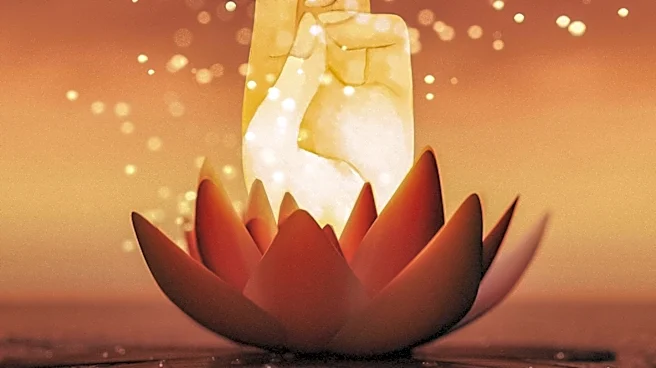





The Sanskrit term "yoni" is a multifaceted word with deep roots in Hindu and yogic traditions, carrying a range of meanings that extend far beyond its common association with a specific hand gesture. While "yoni mudra" is a recognized practice, the word "yoni" itself appears in ancient texts like the Rigveda and other Vedic literature, signifying feminine life-creating regenerative and reproductive organs. However, its meaning is not limited to the physical;
it also encompasses concepts such as "source, origin, fountain, place of birth, womb, nest, abode, [and] fire pit of incubation."
Yoni as a Spiritual Metaphor and Icon
In Hinduism, "yoni" functions as a profound spiritual metaphor and icon, representing the origin and the feminine regenerative powers inherent in the nature of existence. It is often conceptualized as nature's gateway of all births, particularly within esoteric Kaula and Tantra practices, as well as the Shaktism and Shaivism traditions. The Brahma Sutras even metaphorically refer to the metaphysical concept of Brahman as the "yoni of the universe," which, according to Adi Shankara's commentaries, signifies the material cause and "source of the universe."
This broad interpretation highlights "yoni" as a symbol of creation and the fundamental principle from which all life emerges. It is an emblem of cosmological significance, symbolizing the female principle in all life forms and the earth's seasonal and vegetative cycles. This makes the yoni a powerful representation of the divine eternal process of creation and regeneration, and the union of the feminine and the masculine that recreates all of existence.
Yoni in Conjunction with Lingam and Shakti
Often, the yoni is depicted alongside the lingam, its masculine counterpart. Together, they symbolize the merging of microcosmos and macrocosmos, representing the union of feminine and masculine energies that drive creation. This pairing is a symbol for *prakriti*, the primordial matter, and its cyclic creation and dissolution. The yoni is considered an abstract or aniconic representation of the Hindu goddess Shakti, the creative force that moves through the entire universe, and Devi, the divine feminine.
According to Corinne Dempsey, a professor of Religious Studies, the yoni is an "aniconic form of the goddess" in Hinduism, embodying the feminine principle of Shakti. In Tantra, the yoni is explicitly understood as the origin of life. This emphasizes its role not just as a symbol of female anatomy, but as a powerful representation of cosmic creative energy and the fundamental source of existence.
Historical and Archaeological Perspectives on Yoni
The reverence for yoni is believed to be pre-Vedic, with figurines from the Zhob valley dating back to the 4th millennium BCE showing pronounced breasts and yoni, possibly as fertility symbols that evolved into spiritual icons. David Lemming suggests the yoni worship tradition dates to the pre-Vedic period, between 4000 BCE and 1000 BCE. It is considered by some to be one of the oldest spiritual icons, not only in India but across many ancient cultures.
Archaeological findings from Harappan sites, such as polished stones with holes, were proposed by John Marshall and Ernest Mackay as evidence of yoni-linga worship in the Indus Valley civilization. While some scholars, like Arthur Llewellyn Basham, dispute whether these artifacts are indeed yonis, others, including Jones and Ryan, state that lingam/yoni shapes have been recovered. Jane McIntosh notes that while truncated ring stones with holes were once considered yonis, later studies suggest they were pillar components, though their architectural use doesn't preclude simultaneous religious significance. Asko Parpola, while acknowledging the slender grounds for Marshall's and Mackay's initial hypotheses, points to re-examination of Indus Valley sites revealing erotic and sexual scenes, suggesting that Mackay's hypothesis regarding the presence of yoni symbols cannot be entirely ruled out.