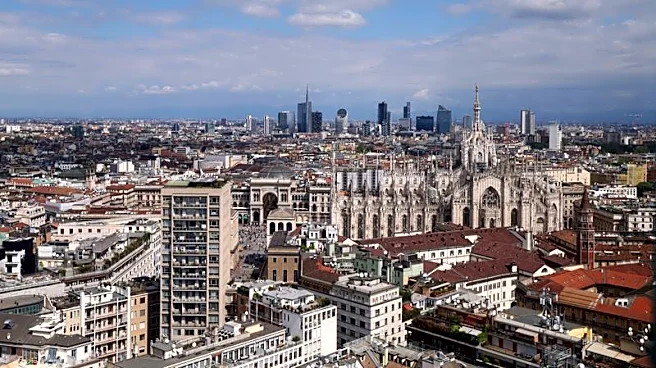








Milan stands as Italy's second-largest city, a vibrant metropolis that serves as the regional capital of Lombardy and the seat of the Metropolitan City of Milan. With a population of 1,362,863 in 2026, it is surpassed only by Rome in terms of inhabitants. However, its wider metropolitan area is the largest in Italy and the fourth-largest in the European Union, boasting an estimated population of 6.55 million. This significant population base underpins
Milan's status as Italy's economic capital, with its metropolitan area contributing approximately 20% of the country's Gross Domestic Product (GDP).
A Central Node in European Transport
Milan's strategic location and economic importance are further amplified by its role as one of the key transport nodes in Italy and southern Europe. The city's central railway station is a major hub, ranking as Italy's second busiest after Rome Termini and Europe's eighth busiest overall. This extensive rail network connects Milan to various parts of Italy and beyond, facilitating both passenger and freight movement crucial for its economic activities.
Beyond its railway infrastructure, Milan is served by three significant airports: Malpensa, Linate, and Orio al Serio. These airports cater to the Greater Milan area, which is the largest metropolitan area in Italy, ensuring robust air connectivity for both domestic and international travel. The presence of multiple airports underscores Milan's importance as a gateway for business and tourism, further solidifying its position as a central point in the European transport landscape.
Metropolitan Growth and Infrastructure
The Metropolitan City of Milan, distinct from the wider metropolitan area, encompasses the city of Milan and 132 other municipalities. With a population of 3,253,111, it is the second most populous metropolitan city in Italy, following the Metropolitan City of Rome Capital. This administrative entity replaced the former province of Milan and has been operational since January 1, 2015, established by Law 56/2014 after being first created by the reform of local authorities (Law 142/1990).
Significant investments in transport infrastructure continue to enhance Milan's connectivity. Since late 2009, two high-speed train lines have linked Milan to major Italian cities like Rome, Naples, and Turin, drastically reducing travel times. Further high-speed lines are currently under construction, aiming to connect Milan with Genoa and Verona. The city also benefits from direct international train services to European cities such as Nice, Marseille, Lyon, Paris, Lugano, Geneva, Bern, Basel, Zurich, and Frankfurt, alongside overnight sleeper services to Munich. This continuous development of its transport network is vital for sustaining Milan's economic dynamism and its role as a pivotal European center.