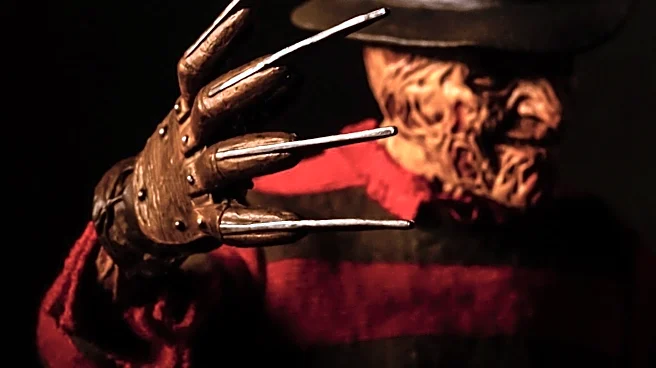









The character of Freddy Krueger, the supernatural serial killer who stalks teenagers in their dreams, has transcended his cinematic origins to become a pervasive figure across various forms of media. Beginning with Wes Craven's 1984 film "A Nightmare on Elm Street," the franchise has expanded significantly, encompassing films, television series, comics, video games, and novels. This widespread adaptation has allowed for diverse interpretations of Krueger and his terrifying
abilities, shaping how audiences experience the iconic horror villain and the Elm Street universe.
From Film to Interactive Terror: The 1990 Video Game
One notable expansion of the franchise was the 1990 video game "A Nightmare on Elm Street" for the Nintendo Entertainment System. Developed by Rare and published by LJN, this game offered a unique interactive experience. Players took on the role of ordinary teenagers, tasked with collecting Freddy Krueger's bones and disposing of them in a high school furnace. The game featured a horizontal side-scrolling beat 'em up style, where players navigated environments filled with hostile creatures like zombies, skeletons, and minotaurs.
A key gameplay mechanic was the "Sleep Meter," which indicated how close a player was to falling asleep. If the meter drained, players were transported to the "Dream World," where Freddy's attacks were more potent. This mechanic directly translated the film's core concept of dream-based vulnerability into gameplay. Players could increase their Sleep Meter by collecting coffee and return from the Dream World by finding a boombox, adding strategic elements to the horror experience. This adaptation showcased an early attempt to translate the psychological terror of the films into an engaging video game format.
Literary and Television Explorations of Elm Street
The "A Nightmare on Elm Street" universe also found its way into literature, with novels like "A Nightmare on Elm Street: Protégé" (2005) by Tim Waggoner and "A Nightmare on Elm Street: Perchance to Dream" (2006) by Natasha Rhodes. These British horror novels, published by Black Flame, delved deeper into Freddy's mythology and introduced new characters and conflicts. "Protégé" explored a teenager named Jerome Starkey attempting to resist Freddy's influence, while "Perchance to Dream" featured Jacob, a young man with telepathic abilities to suppress dreams, battling Krueger.
These novels often expanded on Freddy's origins and powers, such as his connection to Dream Demons and the concept of a Deathstone. The television series "Freddy's Nightmares," which ran for 44 episodes from 1988 to 1990, further broadened the narrative scope, offering episodic tales within the Elm Street world. This variety in storytelling formats allowed the franchise to explore different facets of horror, character development, and the psychological impact of Freddy's reign of terror.
The 2010 Film Remake and Modern Appearances
The franchise saw a significant revival with the 2010 film remake, also titled "A Nightmare on Elm Street," distributed by Warner Bros. Pictures. This film aimed to re-envision the original story for a new generation, focusing on a darker, less comical Freddy Krueger. Beyond standalone adaptations, Freddy Krueger has also made appearances in other popular video games, including the 2011 "Mortal Kombat" game, the mobile version of "Mortal Kombat X," and "Dead by Daylight." These crossover appearances demonstrate Freddy's enduring cultural impact and his status as a recognizable figure in the horror genre, capable of terrifying audiences across various interactive platforms.