







The 13th Ryder Cup Matches, held in November 1959 at the Eldorado Country Club in Indian Wells, California, showcased the intense match play format that defined the competition for decades. The United States team ultimately triumphed over Great Britain with a decisive score of 8½ to 3½ points. This event was particularly notable as it marked the final time the Ryder Cup would be contested under its original 36-hole match play format, which had been
in place since the tournament's inception in 1927.
Understanding the 1959 Match Play Format
The Ryder Cup in 1959 adhered to a specific structure designed to test both team synergy and individual skill. The competition was divided into two main days. The first day featured four foursome matches, where two players from each team formed a partnership and alternated shots using a single ball. These matches were crucial for establishing early momentum. The second day consisted of eight singles matches, pitting individual players against each other in direct competition. Each match, whether foursome or singles, was worth one point, and a total of 12 points were available. A team needed to secure 6½ points to win the Ryder Cup. A key characteristic of this format was that all matches were played to a maximum of 36 holes, allowing for extended and often dramatic contests.
This 36-hole match play format was a hallmark of the Ryder Cup until 1959. The subsequent tournament in 1961 introduced significant changes, including a doubling of the total points available from 12 to 24, and a shift to 18-hole matches. This makes the 1959 event a historical marker, representing the culmination of an era in Ryder Cup play.
Friday's Foursome Matches: Close Contests and Strategic Plays
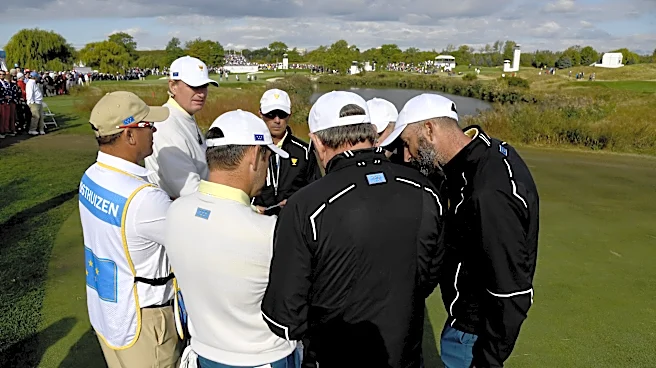
The opening day of the 1959 Ryder Cup featured four foursome matches, and several proved to be tightly contested affairs. Two of these matches went down to the very last hole, demonstrating the competitive spirit of both teams. In one notable pairing, the American team of Boros and Finsterwald found themselves 1 up against Great Britain's Rees and Bousfield as they approached the 36th hole. The match concluded when the British pair's second shot landed in the water, requiring them to take four strokes to reach the green, which ultimately sealed the victory for the American duo.
Another dramatic foursome involved Great Britain's Weetman and Thomas, who held a 1 up lead over the American pair of Sam Snead and Middlecoff as they played the final hole. In a pivotal moment, Snead's second shot also found the water. However, in a decision that later drew criticism, Weetman similarly hit his second shot into the water. Middlecoff then executed a precise chip shot to within eight feet of the hole, and Snead successfully sank the putt. This sequence of events resulted in the Americans winning the hole and halving the match, preventing a full point for Great Britain. The 18-hole scores from the foursomes showed Rosburg/Souchak 6 up, Boros/Finsterwald 1 up, O'Connor/Alliss 2 up, and Snead/Middlecoff 1 up, indicating strong performances from the American side.
The United States Dominance and the Overall Result
The United States team, captained by Sam Snead, demonstrated strong play throughout the two days of competition. Their victory by a margin of 8½ to 3½ points underscored their dominance in this particular Ryder Cup. The overall score reflected a consistent performance across both the foursome and singles matches. The American team's ability to secure crucial points, even in tightly contested matches like the halved foursome involving Snead and Middlecoff, contributed significantly to their win. This victory further solidified the United States' standing in the Ryder Cup series during this period, marking a successful defense of the Cup on home soil before the format underwent its significant transformation.