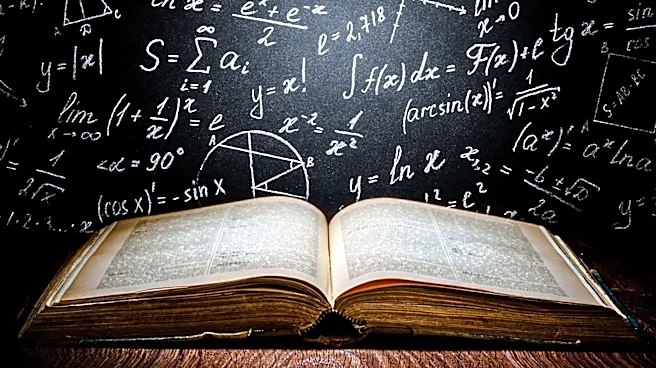









Calculus is a fundamental branch of mathematics dedicated to the study of continuous change. Often referred to as the principal precursor of modern mathematical analysis, it was originally known as infinitesimal calculus or the calculus of infinitesimals. This powerful mathematical tool is essential for solving problems where quantities vary over time or in relation to another reference value, earning it the description as the "mathematical backbone"
for such challenges and "the basic instrument of physical science." Its concepts and techniques have broad applications across science, engineering, and other mathematical fields.
The Two Major Branches: Differential and Integral Calculus
Calculus is primarily divided into two major branches: differential calculus and integral calculus. Differential calculus focuses on instantaneous rates of change and the slopes of curves. It provides a way to understand how a function behaves at a very small scale, essentially encoding the small-scale behavior of a function near a specific point. The process of finding the derivative, which quantifies this steepness, is called differentiation. This branch generalizes the idea of the slope of a straight line, allowing mathematicians to measure the steepness of even complex, non-linear graphs.
Integral calculus, on the other hand, studies the accumulation of quantities and the areas under or between curves. It involves two related concepts: the indefinite integral (also known as the antiderivative) and the definite integral. The indefinite integral is essentially the reverse operation of the derivative. The definite integral, however, takes a function and outputs a number, representing the algebraic sum of areas between the function's graph and the x-axis. These two major branches are intrinsically linked by the fundamental theorem of calculus, highlighting their complementary nature in understanding continuous change.
Evolution of Core Concepts: From Infinitesimals to Limits
Historically, calculus was developed by working with very small quantities, initially through the concept of infinitesimals. These were envisioned as objects that could be treated like real numbers but were, in some sense, "infinitely small" – greater than zero but smaller than any positive real number. From this perspective, calculus was a collection of techniques for manipulating these infinitesimals. However, the notion of infinitesimals proved difficult to make precise, leading to their decline in academic favor during the 19th century.
Infinitesimals were eventually replaced by the epsilon-delta approach to limits, which provided a more rigorous conceptual foundation for calculus. Limits describe how a function behaves at a certain input by examining its values at nearby inputs, capturing small-scale behavior using the intrinsic structure of the real number system. In this modern treatment, calculus is understood as a collection of techniques for manipulating these limits. While infinitesimals were largely set aside for a time, the concept saw a revival in the 20th century with the introduction of non-standard analysis and smooth infinitesimal analysis, which offered solid foundations for their manipulation.
Practical Applications and Generalizations
Calculus provides a generalization of concepts found in elementary geometry and algebra. For instance, while elementary geometry offers formulas for the area of simple shapes like triangles and squares, calculus provides methods to find the area of shapes with boundaries described by complex formulas. Similarly, in elementary algebra, one can calculate the distance traveled by an object moving at a constant velocity, but calculus allows for the calculation of distance even when velocity varies. This ability to handle variable quantities makes calculus an indispensable tool across numerous scientific and engineering disciplines.
Physics, in particular, makes extensive use of calculus. Concepts in classical mechanics and electromagnetism are interconnected through calculus. For example, Newton's second law of motion, which states that the derivative of an object's momentum with respect to time equals the net force acting upon it, is a direct application of differential calculus. Alternatively, this law can be expressed as net force equaling mass times acceleration, where acceleration is the time derivative of velocity and the second time derivative of spatial position. This demonstrates how calculus enables the calculation of distance traveled even when an object's acceleration is known, showcasing its profound utility in describing the physical world.