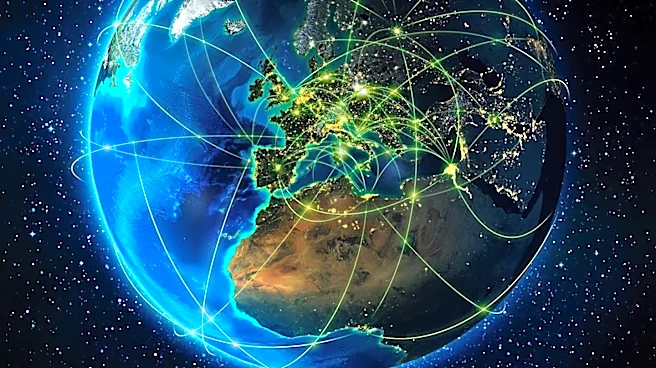








Morse code, developed by Samuel Morse and Alfred Vail, was a revolutionary advancement in communication technology. This article examines the impact of Morse code on global communication, highlighting its role in connecting people across vast distances and its enduring legacy.
Development and Adoption
The development of Morse code was driven by the need for a simple and efficient method of transmitting information over long distances. Samuel Morse's collaboration with Alfred
Vail led to the creation of a code that used dots and dashes to represent letters and numbers. This system was first demonstrated in 1838 and quickly gained traction due to its simplicity and effectiveness.
Morse code's adoption was facilitated by the construction of telegraph lines, which allowed messages to be transmitted across the United States and eventually the world. The code became the standard for telegraphy, enabling rapid communication between cities, countries, and continents. By 1850, telegraphic lines had spread throughout the United States, with 12,000 miles of wire laid, marking a significant milestone in global connectivity.
Transforming Communication
Morse code transformed communication by making it possible to send messages quickly and accurately over long distances. Prior to its invention, communication was limited to physical mail, which was slow and unreliable. Morse code allowed for real-time transmission of information, revolutionizing industries such as journalism, commerce, and diplomacy.
The impact of Morse code extended beyond commercial use. It played a crucial role in military communication, enabling armies to coordinate movements and strategies effectively. During World War II, Morse code was used extensively for encrypted messages, highlighting its importance in secure communication.
Legacy and Modern Applications
Despite the advent of new technologies, Morse code's legacy endures. It remains a symbol of innovation and connectivity, representing the power of communication to bridge distances and unite people. Morse code is still used in certain applications, such as aviation and amateur radio, where its simplicity and reliability are valued.
The influence of Morse code can be seen in modern communication technologies, which continue to build on the principles of efficient and rapid information transmission. The development of digital communication systems, such as the internet and mobile networks, owes much to the groundwork laid by Morse code.
Morse code's impact on global communication is a testament to the ingenuity of Samuel Morse and Alfred Vail. Their invention not only revolutionized the way people communicated but also paved the way for future advancements in technology, shaping the world we live in today.