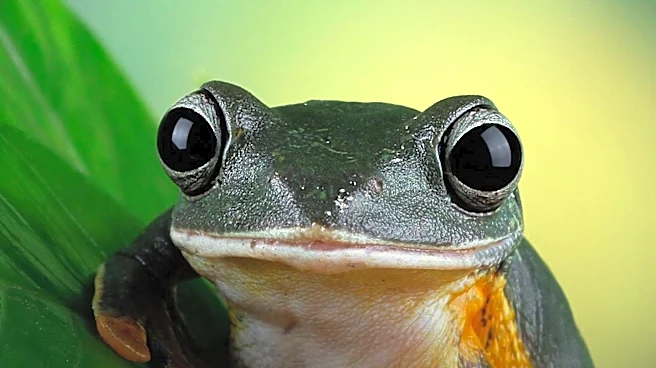







The Australian green tree frog, also known as White's tree frog, is a widespread amphibian found across northern and eastern Australia and the lowlands of New Guinea. Its adaptability allows it to inhabit a variety of environments, from moist forests to suburban settings. This species is notable not only for its broad geographical reach but also for its remarkable ability to coexist with humans, often making its home in unexpected places within residential
areas.
Geographical Range and Habitat Preferences
The green tree frog's native range spans from the Kimberley region of Western Australia, through the Northern Territory and Queensland, to north and central New South Wales, and the extreme northeasterly part of South Australia. In New Guinea, its distribution extends from Irian Jaya to Port Moresby, with a particular abundance on Daru Island. The IUCN notes "scattered locations" in both New Guinea and Indonesia. Its total land occupancy is estimated to be around 4,078,600 square kilometers (1,574,800 sq mi), primarily in areas with warm, wet tropical climates.
While they prefer moist forests, these frogs are not strictly limited to tropical rainforests. They are frequently found in the canopy of trees near water bodies but can also occupy terrestrial habitats far from water. They favor old stands of Eucalyptus trees, where water collects in hollows. They are common along inland waterways and can survive in swamps, among reeds, or in grasslands in cooler climates. This flexibility in habitat selection contributes to their widespread distribution and resilience.
Introduced Populations and Conservation Status
Beyond its native range, the Australian green tree frog has been introduced to other parts of the world. In the United States, small populations have been found in two regions within Florida, likely introduced through the pet trade. The ecological impact of these invasive populations is currently unknown. In New Zealand, several individuals were intentionally released in the late 19th century, and an accidental introduction occurred in the 1940s. However, no sightings have been reported in New Zealand since the 1950s, suggesting that these populations may have died out.
The International Union for Conservation of Nature (IUCN) lists the green tree frog's conservation status as "Least Concern." This classification is due to its broad range, large total population, and tolerance for various habitat types. The population trend appears stable, and any decline is not considered rapid enough to warrant a more threatened category. Australian law provides protected status to the green tree frog, along with all Australian fauna, under the federal Environment Protection and Biodiversity Conservation Act 1999.
Coexistence with Humans and Urban Adaptations
Green tree frogs are remarkably untroubled by human presence and often live in close association with people. They are frequently discovered inside houses, sometimes in sinks and toilets. They can also be found on outside windowsills at night, drawn by insects attracted to the light, and may gather under outdoor lighting for the same reason. These frogs sometimes occupy tanks (cisterns), downpipes (downspouts), and gutters, as these locations offer high humidity and are typically cooler than the external environment. During the mating season, they may be particularly drawn to downpipes and tanks because these structures amplify their calls.
An interesting aspect of their behavior is their apparent homing ability. Green tree frogs have been shown to return to their original locations from considerable distances after being displaced. This suggests a strong connection to their chosen territories, even when those territories are within human-modified landscapes. While generally robust, in suburban areas, these frogs face threats from pollution and predation by domestic animals. Additionally, some individuals have been found infected with chytrid fungus, which causes the fatal amphibian disease chytridiomycosis. Despite these challenges, their adaptability allows them to persist in many human-dominated environments.