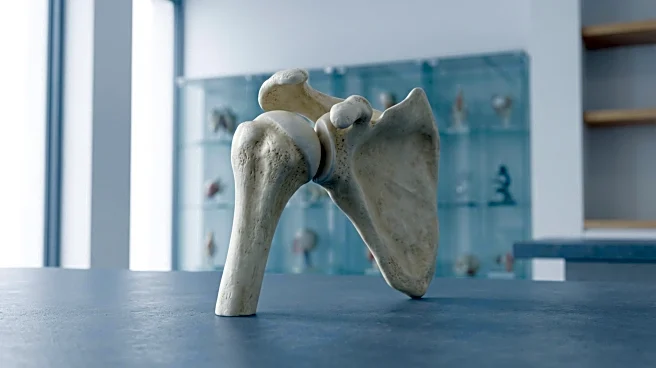
The upper, or proximal, extremity of the humerus is a marvel of anatomical engineering, specifically designed to facilitate the wide range of motion characteristic of the human shoulder. This complex region is where the humerus articulates with the scapula, forming the glenohumeral joint. It comprises several distinct features: a large, rounded head, a constricted neck, and two prominent projections known as the greater and lesser tubercles. Each
component plays a crucial role in the stability, movement, and muscle attachment necessary for arm function.
The Humeral Head and Its Necks
At the very top of the humerus is its head, or caput humeri, which is nearly hemispherical in shape. This rounded structure is directed upward, medialward, and slightly backward, allowing it to fit precisely into the glenoid cavity of the scapula. This articulation forms the highly mobile glenohumeral joint, commonly referred to as the shoulder joint. The circumference of this articular surface is subtly constricted, and this specific indentation is termed the anatomical neck. This anatomical neck is obliquely directed, forming an obtuse angle with the main body of the bone. It is most prominent in its lower half, while in the upper half, it appears as a narrow groove separating the head from the adjacent tubercles. The anatomical neck serves as an attachment point for the articular capsule of the shoulder joint and is perforated by numerous vascular foramens, indicating its rich blood supply. Fractures of the anatomical neck are rare.
In contrast to the anatomical neck, there is another constriction located below the greater and lesser tubercles, which is referred to as the surgical neck. This distinction is significant in clinical practice because the surgical neck is a common site for fractures, hence its name. The diameter of the humeral head itself generally exhibits a size difference, being larger in men than in women.
The Greater Tubercle: A Hub for Rotator Cuff Muscles
Positioned laterally and posteriorly on the upper extremity is the greater tubercle, also known as the tuberculum majus or greater tuberosity. This is a substantial projection that serves as a critical attachment site for several muscles essential for shoulder movement, particularly those of the rotator cuff. Its upper surface is rounded and features three distinct flat impressions. The highest of these impressions provides insertion for the supraspinatus muscle, which is involved in arm abduction. The middle impression is where the infraspinatus muscle attaches, contributing to external rotation of the arm. The lowest impression, along with about 2.5 cm of the bone's body below it, is the insertion point for the teres minor muscle, another external rotator. The lateral surface of the greater tubercle is convex, rough, and continuous with the lateral surface of the humeral body. Furthermore, the crest of the greater tubercle forms the lateral lip of the bicipital groove and is the site where the pectoralis major muscle inserts.
The Lesser Tubercle: An Anterior Attachment Point
Anterolaterally placed to the head of the humerus, and somewhat more prominent than the greater tubercle, is the lesser tubercle, or tuberculum minus. This smaller projection is directed medialward and forward. Its primary function is to provide an insertion point for the subscapularis muscle, which is a powerful internal rotator of the arm. Above and in front, the lesser tubercle presents a distinct impression specifically for the tendon of the subscapularis muscle. Like its larger counterpart, the lesser tubercle also contributes to the formation of the bicipital groove; its crest forms the medial lip of this groove and serves as the insertion site for the teres major and latissimus dorsi muscles. Both the greater and lesser tubercles are integral to the proximal part of the humeral shaft, anchoring key muscles that enable the complex movements of the shoulder and arm.