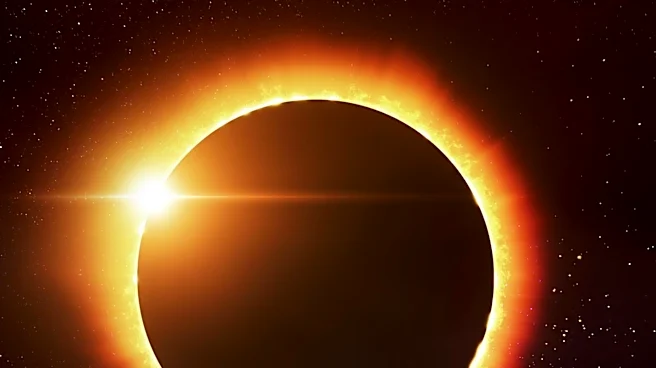






On August 21, 2017, a total solar eclipse captivated observers across the United States, earning it the moniker "The Great American Eclipse." This rare celestial event saw the Moon completely obscure the Sun, casting a shadow that traversed the country from coast to coast. While a partial eclipse was visible in broader regions, the total phase offered a breathtaking experience for those within its narrow path, marking a significant astronomical occasion
for millions.
The Path of Totality: A Cross-Country Journey
The total solar eclipse of August 21, 2017, was unique in its journey across the continental United States. The path of totality, where the Sun was completely covered by the Moon, began on the Pacific coast and stretched all the way to the Atlantic coast. This narrow band, approximately 115 kilometers (71 miles) wide, allowed numerous states to witness the full grandeur of the eclipse. States such as Oregon, Idaho, Wyoming, Nebraska, Kansas, Missouri, Illinois, Kentucky, Tennessee, North Carolina, Georgia, and South Carolina were all within this prime viewing corridor.
For those outside this specific path, a partial eclipse was still visible. This meant that even if the Sun wasn't entirely hidden, a significant portion of it was obscured by the Moon. The partial eclipse extended far beyond the U.S. borders, reaching northern Canada, northern South America, northwestern Europe, northwestern Africa, and even the most eastern part of Asia, making it a widely observed event across multiple continents.
Duration and Characteristics of the Eclipse
The maximum duration of the total phase of the August 21, 2017, eclipse was 160 seconds, or 2 minutes and 40 seconds. This relatively brief period of totality allowed viewers to witness the Sun's corona, its ethereal outer atmosphere, which is typically hidden by the bright solar disk. The eclipse reached its greatest point at 18:26:40 UTC, with the coordinates for maximum eclipse located at 37°00′N 87°42′W.
Astronomical data for this eclipse included a gamma of 0.4367 and a magnitude of 1.0306. These figures describe the geometry of the eclipse, indicating how centrally the Moon's shadow passed across Earth and the extent to which the Sun's diameter was obscured. The eclipse belonged to Saros series 145, specifically being the 22nd of 77 eclipses in that series, and was cataloged as SE5000 #9546. The precise timing of the event, from the partial beginning at 15:46:48 UTC to the partial end at 21:04:19 UTC, allowed for widespread observation and scientific study.
Comparing the 2017 Eclipse to Future Events
The solar eclipse of August 21, 2017, shares interesting similarities with future eclipses, particularly one anticipated in 2045. The 2017 eclipse's path of totality over the U.S. was notably similar to the projected path of the August 12, 2045, eclipse, though the 2017 path was about 250 miles (400 km) to the northeast. Both events are characterized by crossing both the Pacific and Atlantic coasts of the country.
This pattern is attributed to the saros cycle, an astronomical period that helps predict the recurrence of eclipses. When a solar eclipse crosses the U.S. in mid-August at an ascending node, meaning it moves from south to north during odd-numbered saros cycles, its path tends to track from coast to coast. Conversely, when an eclipse occurs at a descending node during even-numbered saros cycles, its path tracks a large distance southward. The 2017 eclipse, being part of an odd-numbered saros, followed this coast-to-coast trajectory, providing a memorable experience for those who witnessed it.