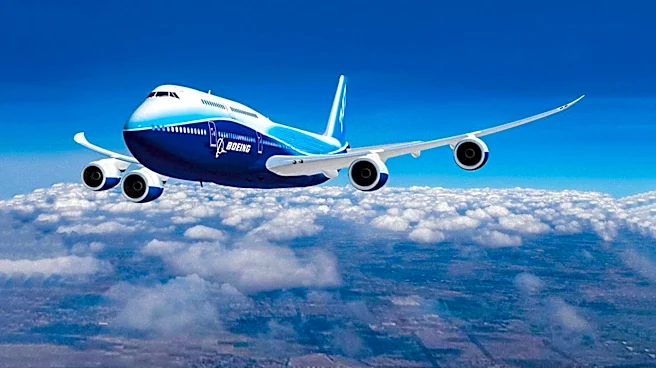

The Boeing 747, often recognized by its distinctive "hump" and nicknamed the "Jumbo Jet" or "Queen of the Skies," represents a monumental achievement in aviation history. Developed by Boeing Commercial
Airplanes, this wide-body jet airliner first took to the skies in 1969, marking a significant leap in aircraft design and capacity. Its creation was not without considerable technical and financial hurdles, pushing the boundaries of engineering and manufacturing. The project was so ambitious that Boeing's management was said to have "bet the company" on its success, a gamble that ultimately paid off, establishing the 747 as a dominant force in air travel for decades.
Origins in Military Transport Needs
The genesis of the 747 can be traced back to a 1963 initiative by the United States Air Force (USAF) to develop an extremely large strategic transport aircraft. Despite the introduction of the C-141 Starlifter, the USAF recognized a need for a much larger and more capable aircraft, particularly one that could carry cargo too large for existing planes. This led to the CX-Heavy Logistics System (CX-HLS) requirements in March 1964, calling for an aircraft with a load capacity of 180,000 pounds, a speed of Mach 0.75, and an unrefueled range of 5,000 nautical miles with a 115,000-pound payload. The cargo bay needed to be substantial: 17 feet wide, 13.5 feet high, and 100 feet long, with access from both the front and rear.
To meet these demanding specifications while limiting the aircraft to four engines, new engine designs were required that offered greatly increased power and improved fuel economy. Boeing, Douglas, and Lockheed submitted airframe proposals, while General Electric, Curtiss-Wright, and Pratt & Whitney proposed engines. A common feature among the airframe proposals was the need to move the cockpit above the cargo area to allow for front loading. Boeing's design, which blended elements from Douglas and Lockheed's concepts, featured a longer pod running from just behind the nose to just behind the wing. Although Lockheed's aircraft design and General Electric's engine design were ultimately selected for the C-5 Galaxy military transport, Boeing carried over the nose door and raised cockpit concepts to the design of the 747, which would become one of its most recognizable features.
Pioneering Design and Manufacturing
The initial design for the 747 considered a full-length double-deck fuselage, but concerns over evacuation routes and limited cargo capacity led to its abandonment in early 1966 in favor of a wider single-deck design. This decision necessitated placing the cockpit on a shortened upper deck, creating the 747's distinctive "hump" and allowing for a freight-loading door in the nose cone. The space behind the cockpit on early models was initially envisioned as a "lounge" area without permanent seating.
A critical technological enabler for an aircraft of the 747's size was the high-bypass turbofan engine. Pratt & Whitney developed the JT9D high-bypass turbofan specifically for the 747, a technology expected to deliver twice the power of earlier turbojets while consuming one-third less fuel. The project also introduced a new methodology called fault tree analysis, which allowed engineers to study the impact of a single part's failure on other systems. To ensure safety and flyability, the 747 incorporated structural redundancy, redundant hydraulic systems, a quadruple main landing gear, and dual control surfaces. Advanced high-lift devices, including Krueger flaps and complex three-part slotted flaps, were integrated to allow the massive aircraft to operate from existing airports, increasing wing area by 21% and lift by 90% when fully deployed.
The Race Against Time and Financial Stakes
Boeing committed to delivering the first 747 to Pan Am by the end of 1969, leaving only 28 months for design and construction—a mere two-thirds of the normal development time. This intense schedule earned the project's workforce the nickname "The Incredibles." The sheer scale of the aircraft also meant Boeing lacked a facility large enough for assembly, prompting the construction of a new plant near Everett, Washington. This site, acquired in June 1966, required moving over four million cubic yards of earth to level the ground. The factory itself became the largest building by volume ever constructed, and its full-scale mock-up was built before the roof was even finished.
The development was fraught with challenges. The program cost reached US$1 billion by 1968, equivalent to $6.9 billion in 2024 dollars. During flight testing, issues arose, including oscillations in the wings under certain conditions, which were partly resolved by reducing the stiffness of some wing components and, in early models, by inserting depleted uranium counterweights in the outboard engine nacelles. Problems with the JT9D engines, such as stalls during rapid throttle movements and turbine casing distortion, further delayed deliveries. Despite these setbacks, the first 747 was rolled out on September 30, 1968, and made its maiden flight on February 9, 1969. The aircraft received its FAA airworthiness certificate in December 1969, with Pan Am initiating commercial service in January 1970. The immense financial investment meant Boeing had to borrow heavily, with its debt exceeding $2 billion, making the project a true "bet the company" endeavor that ultimately secured Boeing's monopoly in very large passenger aircraft production for many years.