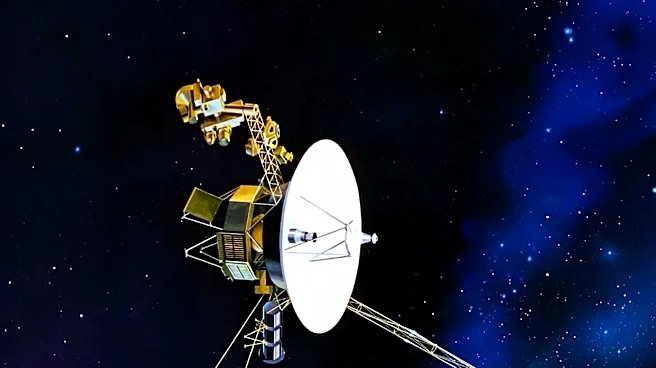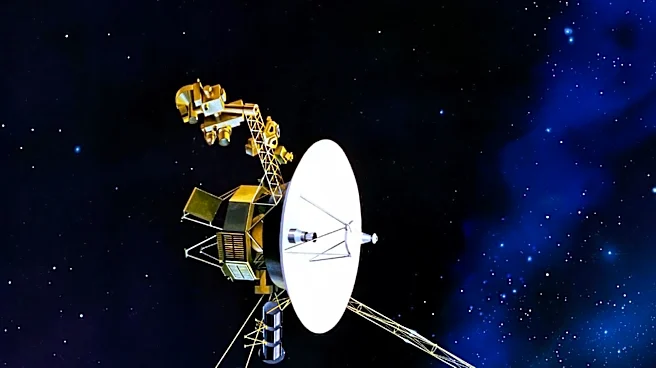

The Voyager 2 spacecraft, launched by NASA in 1977, stands as a testament to remarkable engineering and design, enabling it to operate for decades beyond its initial mission. Built by the Jet Propulsion
Laboratory (JPL), a division of Caltech, the probe was conceived with redundant systems to ensure its survival through an ambitious "Grand Tour" of the outer planets. Its robust design, particularly in its power, propulsion, and communication systems, has allowed it to not only complete its primary mission but also to continue transmitting valuable scientific data from interstellar space, making it one of the most enduring human-made objects ever launched.
Sustaining Power in Deep Space: Radioisotope Thermoelectric Generators
Central to Voyager 2's longevity are its three multihundred-watt radioisotope thermoelectric generators (MHW RTGs). These RTGs are essentially nuclear batteries, each containing 24 pressed plutonium oxide spheres. At the time of launch, these three units collectively provided the spacecraft with approximately 470 watts of electrical power. The power output of these RTGs gradually diminishes over time, halving every 87.7 years. Despite this decay, the RTGs were initially predicted to allow operations to continue until at least 2020, a prediction that has been surpassed through diligent management.
Engineers have continuously worked to optimize power usage. For instance, in October 2024, the plasma science instrument was turned off to conserve power for the remaining four instruments. Further strategic decisions were made, such as the plan announced in March 2025 to shut off the low-energy charged particle (LECP) instrument. A notable achievement in power management occurred on August 4, 2026, when JPL engineers executed a complex "simultaneous" swap of multiple power-consuming devices for lower-power alternatives. This maneuver, dubbed