
The 1946 PGA Championship, held from August 19 to 25 at the Portland Golf Club in Oregon, represented a significant moment for professional golf in the United States. It was the 28th iteration of the championship
and, crucially, the first "full field" event since 1941. The intervening years had seen the tournament either reduced in size or canceled due to World War II, making the 1946 championship a symbol of the sport's resurgence and a return to its traditional scale and competitive intensity.
Reinstatement of the Full Field
Prior to 1946, the PGA Championship had been significantly impacted by the global conflict. The field size for the match play bracket was reduced to 32 competitors in 1942, 1944, and 1945, and the championship was not played at all in 1943. The 1946 event, with its full complement of 64 professionals advancing to match play after a stroke play qualifier, signaled a return to the pre-war standard. This expansion of the field meant more opportunities for golfers and a more robust competition, reflecting a broader societal shift back towards peacetime activities and large-scale sporting events.
The tournament's structure was a demanding one, typical of the era's match play championships. It began with a 36-hole stroke play qualifier, spread over Monday and Tuesday, with 18 holes played each day. The defending champion, Byron Nelson, along with the top 63 professionals from this qualifier, advanced to the match play rounds. The match play portion was intense, featuring 18-hole matches on Wednesday for the first two rounds, followed by 36-hole matches for the third round on Thursday, the quarterfinals on Friday, the semifinals on Saturday, and the final on Sunday. This rigorous schedule tested the endurance and skill of every participant.
Key Performances and Outcomes
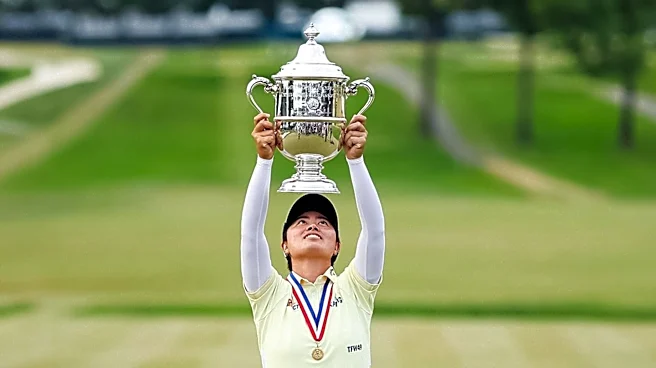
Ben Hogan emerged as the champion, defeating Ed Oliver 6 and 4 in the final match. Hogan's victory was particularly notable as he overcame a three-hole deficit after the morning's 18 holes to secure the win in the afternoon. This marked Hogan's first of nine major titles, a significant achievement that launched a legendary career. The winner's share for Hogan was $3,500, while Oliver, as the runner-up, received $1,500.
Other notable performances included Oliver's victory over defending champion Byron Nelson in the quarterfinals, a tight match that Oliver won 1 up. Nelson's loss was significant, marking his final appearance at the PGA Championship. In the semifinals, Hogan defeated Jimmy Demaret 10 and 9, and Oliver beat Jug McSpaden 6 and 5, setting up the final showdown. Jim Ferrier was the medalist in the stroke-play qualifying portion, achieving a record-setting 29 on the front nine of the second round for a PGA event. Ferrier would go on to win the PGA Championship title the following year in 1947.
The Host Venue and Its Legacy
The Portland Golf Club in Oregon provided a fitting backdrop for this important championship. The club had a history of hosting major golf events, having previously hosted the Portland Open on the PGA Tour in 1944 and 1945. Following the 1946 PGA Championship, the Portland Golf Club continued its legacy by hosting the Ryder Cup in 1947, an event where Ben Hogan himself captained the U.S. team. The successful staging of the 1946 PGA Championship at this venue underscored the return of high-caliber professional golf to the national stage after the wartime hiatus, setting a precedent for future tournaments and solidifying the club's place in golf history.