
The Parthenon, originally conceived as a temple to Athena and a treasury in 5th century BC Athens, has undergone a remarkable series of transformations throughout its long history. From its initial role
in classical Greece, it evolved into a Christian church, then an Islamic mosque, and eventually a damaged ruin before its rediscovery and recognition as a global cultural icon. This journey reflects the shifting political, religious, and cultural landscapes of the region, each era leaving its indelible mark on the structure.
Early Transformations: From Pagan Temple to Christian Church
In the final decade of the 6th century, the Parthenon was converted into a Christian church dedicated to the Virgin Mary, sometimes referred to as "Parthenos Maria." This conversion necessitated significant alterations to the building. The orientation was reversed, with the main entrance moved to the west and enlarged. A small apse was constructed at the location of the pronaos, leading to the removal of part of the interior frieze and the central section of the east pediment. The western room became the church's nave, with a baptistery installed in the northwest corner, separated by a stone iconostasis. Three doors were opened to connect the western and eastern rooms. A wooden floor was added between the two levels of columns to create a gallery, and the axial column was replaced by an arch to allow the gallery to encircle the room. Three windows were cut into the gallery level on each side, resulting in the removal of frieze plaques.
Christian iconoclasm also impacted the Parthenon's sculptures during this period. Elements of the pediments were damaged, sometimes irreparably. The metopes on the west, east, and north sides were defaced to the extent that their original representations are now uncertain. However, the south metopes, less visible, and the frieze, perhaps due to its inaccessibility, largely escaped this destruction. By the 10th century, the Parthenon was definitively established as a church dedicated to the Virgin Mary, with Byzantine texts distinguishing between the "pseudo-parthenos" Athena and the "true Virgin" Mary. Further modifications in the 12th century included replacing the early Christian apse with a larger one, integrating two central columns, and installing a new altar and a mosaic of the Virgin and Child in the apse.
Under Ottoman Rule: Mosque and Military Target
In 1456, Ottoman Turkish forces conquered Athens, and by the end of the 15th century, the Parthenon was converted into a mosque. The tower previously constructed during the Roman Catholic occupation was extended upwards to become a minaret. The apse was repurposed into a mihrab, a minbar was installed, and the Christian altar and iconostasis were removed. The walls were whitewashed to cover Christian icons and imagery. Despite these changes, the Parthenon's fundamental structure remained largely intact. The Turkish traveler Evliya Çelebi, in 1667, expressed his awe at the Parthenon's sculptures, describing the building as "like some impregnable fortress not made by human agency."
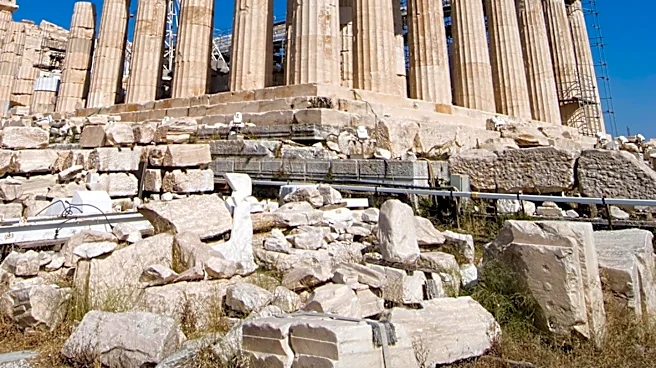
However, this period also brought significant damage. In 1687, during the Morean War, the Venetians attacked Athens. The Ottomans, using the Parthenon's naos as a gunpowder magazine, inadvertently sealed its fate. On September 26, a Venetian mortar round struck the building, igniting the gunpowder and causing a catastrophic explosion. The roof and walls collapsed, and twenty-one columns were destroyed. Many sculptures were severely damaged, both by the blast and by attempts by Francesco Morosini to remove statues from the west pediment, which broke upon falling. After the Venetians withdrew in 1688, the Ottomans reoccupied the Acropolis, and debris from the Parthenon was reused in constructing houses. A smaller mosque was later built within the ruins of the Parthenon, serving the Ottoman garrison.
Rediscovery and Modern Legacy
Despite its damaged state, the Parthenon began to attract renewed attention from Western Europe during the Renaissance Humanism period. Cyriacus of Ancona, in 1436, was the first after antiquity to describe it and refer to it by its original name, calling it