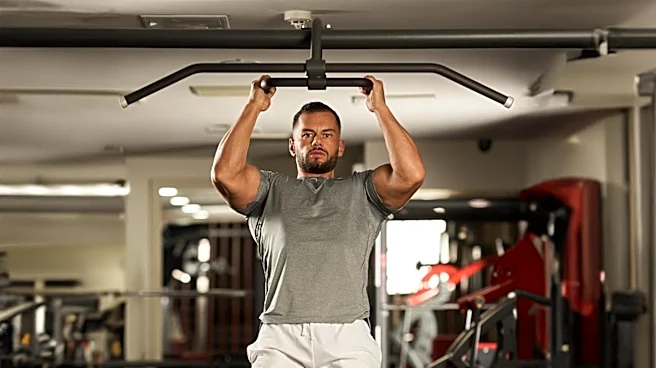







Pull-ups are a fundamental bodyweight exercise renowned for their effectiveness in developing upper body strength. This exercise involves hanging from a stationary bar or similar apparatus with outstretched arms and then pulling the body upwards until the elbows are bent and the head is above the hands. A traditional pull-up relies purely on upper body strength, without any swinging motion, which distinguishes it from movements that incorporate momentum.
The primary muscle targeted is the Latissimus Dorsi, located in the back, alongside numerous assisting muscles. The versatility of pull-ups extends to various forms, each with distinct benefits and muscle engagement patterns.
While often confused with chin-ups, pull-ups differ primarily in hand grip. In a pull-up, the palms face away from the exerciser (pronated grip), whereas in a chin-up, the palms face towards the exerciser (supinated grip). Even if the arms are not fully extended at the start, the movement is still considered a pull-up. This exercise is a closed-chain, compound movement, meaning multiple joints and muscle groups work together, involving flexion at the elbow and adduction or extension of the shoulder joint. The biomechanics of pull-ups are complex, engaging a wide array of muscles throughout the movement.
Biomechanics and Muscle Activation
The execution of a pull-up involves the coordinated effort of several bone segments and muscle groups. The humerus (upper arm), ulna, and radius (forearm) are the primary bones involved. While the latissimus dorsi and biceps brachii are commonly highlighted, many other muscles contribute significantly. During the positive or concentric phase of the exercise, the humerus performs an adduction movement on the frontal plane. Simultaneously, the forearm undergoes flexion, and the scapula experiences depression and adduction. This intricate interplay ensures a powerful and effective pulling motion.
Muscle activation varies throughout the pull-up. At the initial stage, the trapezius, infraspinatus, and brachialis muscles are most active. As the body ascends, the latissimus dorsi, teres major, and biceps brachii reach their peak activity. Finally, at the top of the movement, the triceps brachii and subscapularis exhibit maximum activity. This sequential activation demonstrates the comprehensive nature of the pull-up as an upper body exercise, engaging muscles from the back, shoulders, and arms. The muscle activation in pull-ups shows similarities to the pull-down exercise, indicating shared biomechanical principles.
Variations in Grip and Execution
Pull-ups can be performed with several grip variations, each emphasizing different muscle groups. The classic pronated grip pull-up, with hands placed slightly wider than shoulder-width and palms facing forward, heavily involves the outer part of the latissimus dorsi and, to a lesser extent, the forearms. This grip minimizes biceps involvement. An excessively wide grip shifts the focus to the upper latissimus dorsi and posterior deltoids but can make the lift very difficult and increase injury risk due to reduced arm involvement. Conversely, a narrow grip (shoulder-width) targets the lower latissimus dorsi and maximizes forearm and biceps engagement.
Another common variation is the supinated grip pull-up, or chin-up, where palms face the exerciser. This grip primarily targets the central part of the latissimus dorsi and significantly maximizes biceps involvement, while reducing forearm work. Chin-ups are excellent for simultaneously training biceps and lats but can be stressful on the wrists due to the unnatural position. A narrow grip in chin-ups helps mitigate wrist strain. The neutral grip pull-up, using parallel handles with palms facing each other, offers a balanced approach. It effectively engages the entire latissimus dorsi, especially the central part, and provides considerable arm involvement, intensely stimulating forearms, the brachialis muscle, and biceps. This grip is often considered safer for joints and allows for both very narrow and very wide grips more comfortably than other variations.
Advanced Techniques and World Records
Once an individual can perform a significant number of bodyweight pull-ups (typically around 15), they can progress to weighted pull-ups. This involves attaching weights to a belt, allowing for a focus on strength and muscle mass gains rather than just muscular endurance. Weighted pull-ups are crucial for continued strength development, as a high number of repetitions primarily benefits endurance with only minor gains in mass and maximum strength.
Pull-ups are also a benchmark for incredible feats of strength and endurance, with several Guinness World Records dedicated to the exercise. Kenta Adachi from Japan holds the record for the most consecutive pull-ups, achieving 1224 in 2024. Joonas Mäkelto holds the record for pull-ups with no breaks, completing 88. The heaviest weighted pull-up record belongs to Liu Weiqiang from China, who lifted 146.64 kg in 2025. For endurance, Enrique Zapata from Mexico set the record for most pull-ups in 24 hours (male) with 12,345 in 2026, while Olivia Vinson from Australia holds the female record with 7,079 pull-ups in 2025. These records highlight the extreme levels of strength and stamina that can be achieved through dedicated pull-up training.