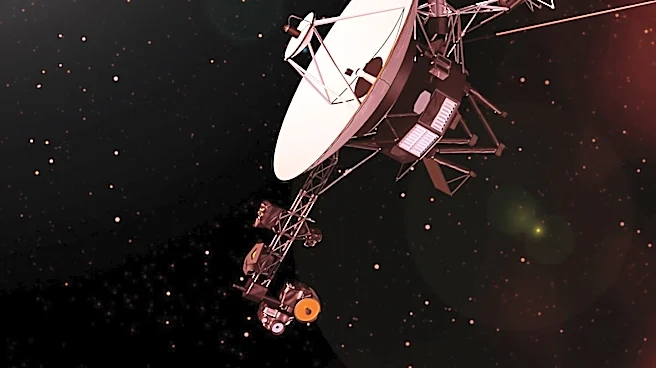




The Voyager 2 spacecraft embarked on an ambitious journey that redefined humanity's understanding of the outer Solar System. Launched in 1977, its primary mission initially focused on Jupiter and Saturn, but its unique trajectory and the successful completion of its sister craft's objectives allowed for an unprecedented extension. This extension transformed Voyager 2's mission into a grand tour, making it the only spacecraft to visit Uranus and Neptune,
providing invaluable data and images of these distant worlds and their complex systems.
The Genesis of a Grand Tour
The concept of a "Grand Tour" of the outer planets emerged in the early space age, recognizing a rare alignment of Jupiter, Saturn, Uranus, and Neptune that would occur in the late 1970s. This alignment presented a unique opportunity to use the then-new technique of gravity assists, allowing a single probe to visit multiple planets and significantly reduce travel time and fuel requirements. Initially, NASA's Grand Tour project was envisioned as a massive undertaking involving two groups of two probes each, with one group targeting Jupiter, Saturn, and Pluto, and the other Jupiter, Uranus, and Neptune. These spacecraft were designed with redundant systems to ensure their survival throughout the extensive tour.
By 1972, the ambitious mission was scaled back, replaced by two Mariner program-derived spacecraft, initially named Mariner Jupiter-Saturn probes. To manage apparent lifetime program costs, the mission was limited to flybys of Jupiter and Saturn, but crucially, it retained the option for the Grand Tour. As the program progressed, these probes were renamed Voyager. The primary mission for Voyager 1 was to explore Jupiter, Saturn, and Saturn's largest moon, Titan. Voyager 2 was also slated for Jupiter and Saturn, but on a trajectory that offered the flexibility to continue to Uranus and Neptune, or to serve as a backup for Voyager 1's Titan flyby.
Extending the Mission: Uranus and Neptune
Upon the successful completion of Voyager 1's objectives, particularly its flyby of Titan, Voyager 2 received a mission extension. This pivotal decision allowed the probe to continue its journey to Uranus and Neptune, fulfilling the long-held dream of a Grand Tour. The trajectory for Voyager 1 was specifically designed for an optimal flyby of Titan, a moon known for its substantial and complex atmosphere, which sent Voyager 1 out of the plane of the ecliptic, effectively ending its planetary science mission. Had Voyager 1 been unable to perform the Titan flyby, Voyager 2's trajectory could have been altered to explore Titan, foregoing any visit to Uranus and Neptune.
Voyager 2's trajectory, however, was designed to allow flybys of all four gas giants. This foresight proved critical, enabling it to become the first and only spacecraft to conduct close-up observations of Uranus in 1986 and Neptune in 1989. These encounters were not just extensions but entirely new chapters in planetary exploration, providing humanity with its first detailed views of these ice giants.
The Neptune Encounter: A Scientific Bonanza
Voyager 2's encounter with Neptune in 1989 marked the culmination of its planetary exploration phase. The probe began taking navigation images of Neptune in May 1988, with the observation phase proper commencing on June 5, 1989. The spacecraft officially reached the Neptunian system on August 25, and data collection continued until October 2. Initially, a trajectory was planned for a close approach of about 1,300 km from Neptune and 8,200 km from its moon Triton. However, the need to avoid ring material, detected by stellar occultations, led to a revised trajectory that largely bypassed the rings but resulted in more distant flybys of both targets.
On August 25, Voyager 2 made its closest approach to Neptune, swooping only 4,950 km above the planet's north pole. This was the closest approach it had made to any body since its launch in 1977. At that time, Neptune was the farthest known body in the Solar System, a distinction it held until Pluto moved further from the Sun in its trajectory in 1999. During this encounter, Voyager 2 meticulously studied Neptune's atmosphere, its ring system, its magnetosphere, and its moons. The data gathered during this flyby remains the best available on Neptune in most cases, settling many long-standing scientific questions and revealing a wealth of information that could not have been obtained through Earth-based observations.
Beyond the Planets: The Interstellar Mission
After successfully fulfilling its primary mission of visiting the Jovian system in 1979, the Saturnian system in 1981, the Uranian system in 1986, and the Neptunian system in 1989, Voyager 2 transitioned into its extended mission: studying the interstellar medium. On November 5, 2018, Voyager 2 entered the interstellar medium, at a distance of 119.7 AU from the Sun, joining Voyager 1, which had reached this region in 2012. Moving at 15.341 km/s relative to the Sun, Voyager 2 has begun to provide the first direct measurements of the density and temperature of the interstellar plasma. As of February 2026, the spacecraft is at a distance of 143.05 AU from Earth, continuing its journey and sending back valuable data from the farthest reaches of human exploration.
The longevity of Voyager 2 is a testament to its robust design. Equipped with three multihundred-watt radioisotope thermoelectric generators (MHW RTGs), each containing 24 pressed plutonium oxide spheres, the spacecraft was initially supplied with 470 watts of electrical power at launch. These RTGs were predicted to allow operations to continue until at least 2020, and they continued to power five scientific instruments through early 2023. In April 2023, JPL began utilizing a reservoir of backup power intended for an onboard safety mechanism, extending the expected operation of all five instruments through 2026. However, power management continues to be a critical aspect of the mission, with some instruments being turned off to preserve power for others, ensuring the spacecraft can continue its groundbreaking scientific observations for as long as possible.