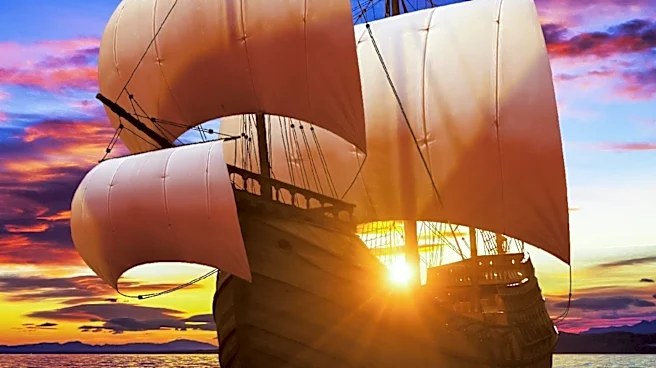



The Columbia Rediviva, often simply called Columbia, holds a significant place in American maritime history. This privately owned American ship achieved the remarkable feat of being the first American vessel to circumnavigate the globe. Beyond this pioneering journey, the Columbia Rediviva was also instrumental in expeditions to the Pacific Northwest, playing a key role in the maritime fur trade. Her story is one of exploration, trade, and the early
expansion of American influence across the seas.
Origins and Renaming
The ship was originally built in 1773 by James Briggs in Norwell, Massachusetts, and was initially known simply as Columbia. However, her name underwent a change upon a significant rebuilding in 1787. It was at this point that "Rediviva," a Latin word meaning "revived," was added to her name, reflecting this reconstruction. This renaming to Columbia Rediviva occurred in Plymouth, Massachusetts, where the rebuilding took place. As a privately owned vessel, she did not carry the "USS" prefix, which is reserved for ships of the United States Navy.
Her general characteristics reveal a robust vessel designed for long voyages. She was a full-rigged ship, meaning she had three masts (foremast, mainmast, and mizzenmast) with square sails. Her length on deck measured 83 feet 6 inches (25.45 meters), with a beam of 24 feet 2 inches (7.37 meters) and a draught of 11 feet (3.4 meters). The ship's tonnage burthen was 213 bm, indicating her carrying capacity. Her propulsion relied entirely on sail, a testament to the sailing technology of the late 18th century.
Crew and Armament
The Columbia Rediviva required a substantial crew to operate effectively on its extensive voyages. Her complement ranged from a minimum of 16-18 individuals to a maximum of 30-31. This crew size was necessary to manage the ship's sails, maintain the vessel, and handle the demands of long-distance travel and trade. The ship was also equipped with armament, reflecting the potential dangers of maritime travel during that era.
Her defensive capabilities included 10 cannons. Specifically, she carried 2 heavy stern chaser guns, which could fire backward, and a combination of 4 heavy and 4 lighter broadside guns, designed to fire from the sides of the ship. This armament would have provided a measure of protection against piracy or other threats encountered during her global circumnavigation and fur trading expeditions. The ship's design and outfitting underscore its dual purpose as both a trading vessel and a ship capable of self-defense in potentially hostile waters.
Decommissioning and Legacy
The Columbia Rediviva's active service concluded in 1806 when she was decommissioned and subsequently salvaged in Boston. Despite her eventual dismantling, her legacy endured. Her pioneering circumnavigation marked a significant achievement for the young United States, demonstrating American seafaring capabilities on a global scale. Furthermore, her expeditions to the Pacific Northwest contributed to the exploration and mapping of that region, and her involvement in the maritime fur trade played a role in early American commerce and expansion. The ship's name also lives on through its association with the Columbia River, which was named after the vessel by Captain Robert Gray in 1792.