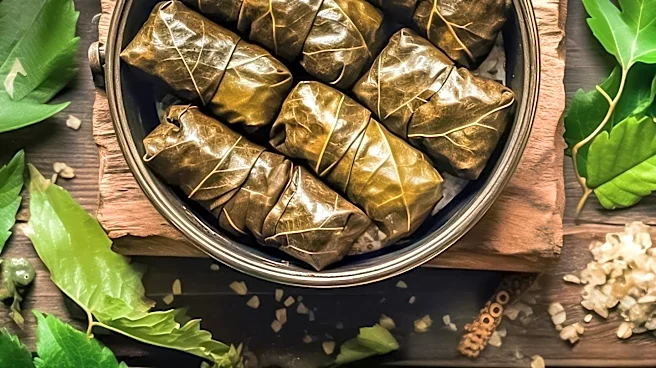







Dolma, a family of stuffed dishes, holds a significant place in the culinary traditions of regions once part of the Ottoman Empire. The name itself, derived from Turkish, means "something stuffed" or "filled," directly reflecting its preparation method. This dish, which typically involves vegetables or leaves filled with a mixture of rice, minced meat, herbs, and spices, has transcended its origins to become a staple food across a vast geographical
area, including the Middle East, the Balkans, the Caucasus, Russia, and Central Asia. Its widespread adoption and enduring popularity underscore its deep cultural roots and historical journey.
The earliest written records of the word "dolma" provide insight into its long history. One of the first attestations appears in Franciscus a Mesgnien Meninski's *Thesaurus Linguarum Orientalium, Turcicæ, Arabicæ, Persicæ* in 1680. In this work, the Ottoman Turkish word "dolma" is defined with the Latin term *ripieno*, also meaning "stuffed" or "filled." Later, in the late 19th century, James William Redhouse's *A Turkish and English Lexicon* (1890) further defined dolma as "an act of filling" and "a dish of meat, fruit, or vegetable, filled with rice, forcemeat, etc." These historical mentions highlight the dish's established presence and recognition over centuries.
The Ottoman Influence and Culinary Spread
The spread of dolma is largely attributed to the Ottoman Empire, which facilitated its dissemination across diverse cultures and cuisines. As the empire expanded, so did its culinary practices, making dolma a common and beloved dish in many post-Ottoman nations. The *Oxford Companion to Food* suggests that the distribution and naming of dolma indicate its origins in the court cuisine of the Ottoman Empire, where stuffed vegetables were first established as a regular culinary genre in Istanbul. This suggests a sophisticated culinary tradition that valued the art of stuffing and filling various ingredients.
While the Ottoman origin is widely acknowledged, the dish's name can sometimes obscure this history, as some countries refer to it by native terms meaning "stuffed." However, the Turkish root of the word "dolma" is evident in many languages, including Azerbaijani, Armenian (where it's known as *tolma*), Greek (*ntolmás*), Arabic (*ḍulma*), Persian (*dolmeh*), Georgian (*ṭolma*), Tatar (*tulma*), Turkmen (*dolâma*), and even Swedish (*dolme*). This linguistic trail further solidifies its Ottoman heritage and the extensive reach of its culinary influence.
Distinctions and Variations Across Regions
Within Turkey, a specific distinction is made between *dolma* and *sarma*. *Dolma* refers to hollowed vegetables that are filled with stuffing, such as tomatoes, peppers, onions, zucchini, or eggplant. *Sarma*, on the other hand, refers to dishes where the filling is wrapped in edible leaves, like vine or cabbage leaves. However, in many other languages and former Ottoman territories, the term "dolma" is used more broadly to encompass both types of stuffed dishes, including those that would be classified as *sarma* in Turkish.
This broad usage highlights the adaptability and evolution of the dish as it integrated into various local cuisines. For instance, in Arabic-speaking countries, Turkish terms are often blended with native ones, such as *maḥshī yabraq* or *maḥshī brag* in Syrian and Kuwaiti Arabic, combining the Turkish word *yaprak* ("leaf") with the Arabic *maḥshī* ("stuffed"). These linguistic and culinary variations demonstrate how dolma has been embraced and localized while retaining its core identity as a stuffed dish, a testament to its enduring appeal and the rich culinary legacy of the Ottoman Empire.