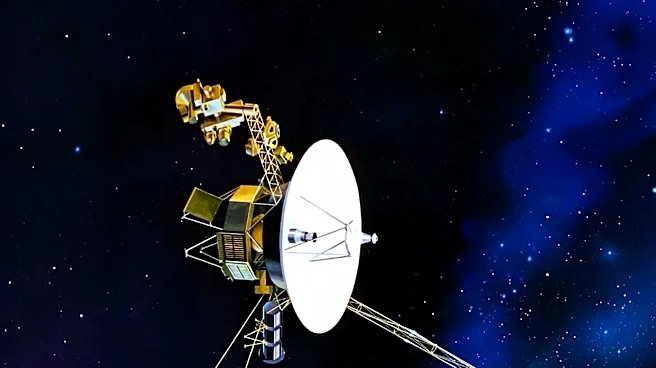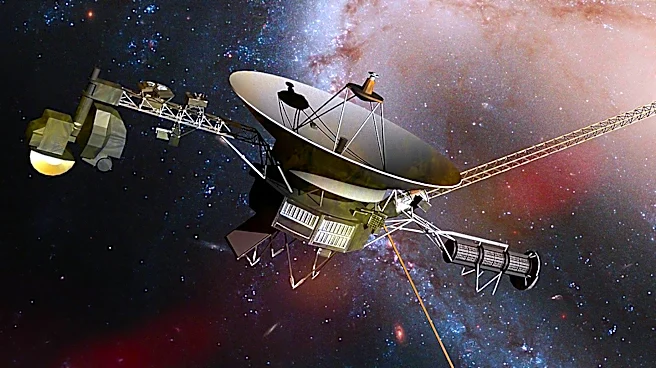

Launched by NASA on August 20, 1977, Voyager 2 embarked on an ambitious journey that would redefine our understanding of the outer solar system. As part of the Voyager program, its primary mission was
to explore the gas giants, Jupiter and Saturn, with the groundbreaking potential to continue on to the ice giants, Uranus and Neptune. This trajectory was made possible by a rare planetary alignment, a phenomenon occurring only once every 176 years, allowing the spacecraft to use gravity assists from each planet to propel it towards the next. Voyager 2 ultimately became the only spacecraft to have visited either of the ice giant planets, making its mission truly unique in space exploration history.
The Genesis of a Grand Tour
In the early days of space exploration, scientists recognized that a specific alignment of the outer planets in the late 1970s offered an unprecedented opportunity. This alignment would allow a single probe to visit Jupiter, Saturn, Uranus, and Neptune by leveraging the then-novel technique of gravity assists. This realization led NASA to conceptualize a "Grand Tour" mission. Initially, this was envisioned as a massive project involving two groups of two probes each, with one group targeting Jupiter, Saturn, and Pluto, and the other focusing on Jupiter, Uranus, and Neptune. The spacecraft were designed with redundant systems to ensure their survival throughout such an extensive tour.
By 1972, the scope of the mission was scaled back, evolving into two Mariner program-derived spacecraft, initially named the Mariner Jupiter–Saturn probes. To manage apparent lifetime program costs, the mission was officially limited to flybys of Jupiter and Saturn, but crucially, the design retained the option for the Grand Tour. As the program progressed, these probes were renamed Voyager. Voyager 1's primary mission was to explore Jupiter, Saturn, and Saturn's largest moon, Titan. Voyager 2 was also slated for Jupiter and Saturn, but on a trajectory that offered the flexibility to continue to Uranus and Neptune, or to serve as a backup for Voyager 1 by being redirected to Titan if needed. Once Voyager 1 successfully completed its objectives, Voyager 2 received a mission extension to proceed towards Uranus and Neptune, capitalizing on the unique planetary alignment.
Encounters with the Gas Giants: Jupiter and Saturn
Voyager 2's journey began with its encounter with Jupiter. Although launched 16 days before its twin, Voyager 1, Voyager 2 followed a different trajectory, reaching Jupiter four months after its counterpart. On July 9, 1979, Voyager 2 made its closest approach to Jupiter, passing within 721,670 km of the planet's center. This trajectory was specifically chosen to complement the data gathered by Voyager 1, including a close flyby of Jupiter's moon Europa (63,130 km), detailed observations of the planet's southern atmosphere, and a thorough study of Jupiter's magnetic tail. The probe also passed near Ganymede (62,130 km) and Callisto (214,930 km), confirming the volcanic activity on Io that Voyager 1 had detected.
Following its Jupiter encounter, Voyager 2 embarked on a 22-month transit to Saturn. On August 26, 1981, nine months after Voyager 1, Voyager 2 passed within 161,000 km of Saturn's center. Its more sensitive cameras allowed for the detection of numerous atmospheric features not seen by Voyager 1. Using its radio instrumentation, Voyager 2 probed Saturn's outer atmospheric layers, measuring temperatures ranging from 82 Kelvin at 70 millibars pressure to 143 Kelvin at 1,200 millibars. The probe was also directed to obtain better views of Saturn's moons than Voyager 1. Despite a temporary platform blockage that caused some data loss, the issue was resolved, and Voyager 2 successfully used Saturn's gravity assist to set its course for Uranus.
Pioneering Exploration of the Ice Giants: Uranus and Neptune
The journey to Uranus presented a new set of challenges and discoveries. Uranus, a gas giant with a diameter of 50,000 km, is unique in our solar system due to its highly inclined rotational axis, which lies almost in its orbital plane around the Sun. A key objective for Voyager 2, the first probe to visit Uranus, was to find clues explaining this peculiarity. On January 24, 1986, Voyager 2 passed within 81,000 km of Uranus and 30,000 km of its moon Miranda. The probe discovered Uranus's magnetic field, which was surprisingly tilted at 55 degrees relative to the planet's rotational axis. It also identified ten new moons, adding to the five already known, and analyzed Uranus's nine rings, noting their distinct characteristics compared to those of Saturn and Jupiter.
Voyager 2's final planetary encounter was with Neptune. On August 25, 1989, the spacecraft made its closest approach to Neptune, passing within 4,950 km of the planet's north pole. This flyby provided the first close-up images of Neptune and its largest moon, Triton. The probe discovered six new moons and confirmed the existence of Neptune's rings, which were found to be incomplete arcs rather than continuous bands. Voyager 2's observations revealed Neptune to be a dynamic planet with strong winds and the Great Dark Spot, a storm system comparable to Jupiter's Great Red Spot. The gravity assist from Neptune propelled Voyager 2 out of the plane of the planets, sending it on its path towards interstellar space, marking the successful completion of its unprecedented Grand Tour of the outer solar system.