





Quebec City, the capital of the Canadian province of Quebec, boasts a rich and complex history that spans centuries, beginning long before European arrival. From its origins as an Indigenous settlement to its pivotal role in the formation of New France and later Canada, the city has witnessed significant transformations. Its strategic location on the Saint Lawrence River made it a crucial site for trade, defense, and governance, shaping its development
into a unique North American urban center with deep ties to its French heritage.
Early Settlements and French Foundations
The history of Quebec City stretches back thousands of years, with the First Nations peoples of the region being its initial inhabitants. French explorers first reached the area in the 16th century, with Jacques Cartier ascending the St. Lawrence Gulf and claiming "Canada" for France. In 1535, Cartier and his crew visited Stadacona, an Iroquois settlement of 500 people located at the site of present-day Quebec City. Cartier returned in 1541 with about 400 individuals to establish Fort Charlesbourg-Royal, the earliest known French settlement in North America, situated at the mouth of the Riviere du Cap Rouge in what is now the former town of Cap-Rouge. However, this fort was abandoned less than a year later due to the harsh winter conditions and resistance from indigenous inhabitants.
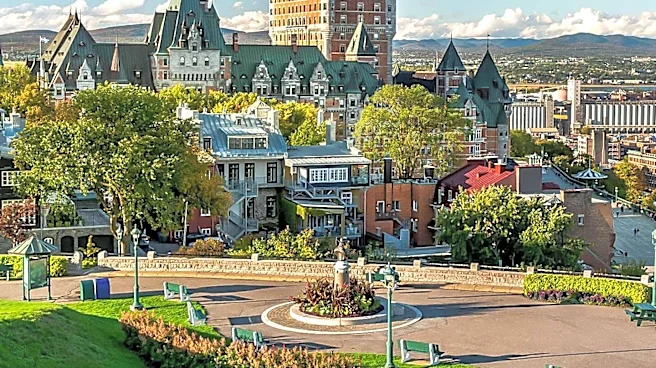
After 1543, fur trading continued in the area, but it wasn't until July 3, 1608, that Samuel de Champlain, a French explorer and diplomat, founded Quebec City as a permanent trading post. Champlain, often called "The Father of New France," established "l'habitation" to house 28 people. The location was strategically advantageous due to its isolation from other traders downstream and its promontory, Cape Diamant, which offered a vantage point for observing vessels moving upstream. The name "Kebec" itself is an Algonquin word meaning "where the river narrows." In 1620, Champlain further solidified French presence by building Fort Saint-Louis atop Cape Diamond, near the current site of the Chateau Frontenac.
Colonial Life and Urban Development
Life in early Quebec City was challenging. The first winter after Champlain's founding proved formidable, with 20 out of 28 men dying. By 1615, the first four missionaries arrived, and successful French settlers like Marie Rollet and her husband, Louis Hebert, began agricultural efforts. The city's population reached 100 by 1627, though less than a dozen were women. The town was briefly captured by English troops from 1629 to 1632 but was returned to France. Upon their return, the French found most buildings destroyed, leading to a reconstruction effort overseen by Charles de Montmagny, the first governor.
Quebec City was designed with a traditional French "ville" framework, reflecting its society. The colonial elites, including clergy and government officials, resided in the upper city, closer to centers of power like the government and the Jesuit college. The lower town was primarily populated by merchants, sailors, and artisans. Despite early attempts at urban planning by Jean Bourdon, the first engineer and surveyor of New France, the city quickly outgrew its planned area. The population steadily increased, reaching 1300 inhabitants by 1681. Overcrowding became an issue, particularly in the lower town, which housed two-thirds of the city's population by 1700. By the 18th century, the distribution became more even, with the lower town holding a third and the upper town nearly half of the inhabitants. The city also saw a rise in rental dwellings to accommodate a mobile population of seamen, sailors, and merchants, earning it the description "a town of tenants."
Economic Life and Shifting Powers
As a port city, Quebec's economy was dominated by shipping and import/exports, facilitated by its deep-water harbor on the St. Lawrence River. It engaged in flourishing trade with the French West Indies and ports in France, though trade was restricted to French vessels and officially French ports. From France, Quebec received wine, textiles, metal products, salt, and luxury goods. From the French West Indies, it imported sugar, molasses, and coffee. To balance its trade, Quebec City exported furs to France and lumber and fish to the West Indies. Between 1612 and 1638, 15,000 to 20,000 beaver pelts, valued at 75,000 livres, were shipped to France. The early 1720s saw a spike in shipping, with an average of 40 ships arriving annually. Despite this, Quebec constantly faced trade imbalances, debt, and financial insecurity, often lacking hard currency, leading to the use of playing cards as money at one point.
At the end of French rule, Quebec was a town of 8,000 inhabitants, characterized by monumental architecture, fortifications, and affluent masonry homes alongside shacks in the suburbs. It remained closely tied to its rural surroundings, with nearby inhabitants trading farm surpluses and firewood for imported goods. The city was also the focal point of religious authority, becoming the seat of the bishop in 1674 with François de Laval as the first bishop, and home to the Séminaire de Québec, founded by Laval in 1663. The British and Canadian rule began in 1763. During the American Revolution, American revolutionary troops assaulted the British garrison in 1775, hoping Quebec would join their cause, but the invasion failed. Amid fears of another American attack during the War of 1812, construction of the Citadelle of Quebec began in 1820. Although no attack occurred, the Citadelle housed a large British garrison until 1871 and remains in military use and a tourist attraction today.
Economic Decline and Modern Resurgence
Until the late 18th century, Quebec was the most populous city in present-day Canada. However, by 1790, Montreal surpassed it in population, though Quebec remained the administrative capital of former New France and later Lower Canada. The city experienced an economic golden age in the 1800s, driven by its favorable location for wooden sailing ship manufacturing, timber export to Europe, and associated industries like sawmills. However, by the 1870s, Quebec City entered a period of economic decline. Factors contributing to this included the rise of steel-hulled steamships, the expansion of railroads over waterways, depletion of forest resources, and the construction of locks on the Saint Lawrence Seaway, which opened trade routes to the U.S. from Montreal. The city's inability to retain immigrant populations also played a role. This led to an exodus of English-speaking populations, such as Scottish bourgeoisie and Irish workers, to Montreal. Anglophones, who made up approximately 40% of the city's population in 1861, decreased to 16% by 1901.
Despite economic challenges, Quebec City continued to hold political significance. It was the capital of the Province of Canada at various times between 1841 and 1867. The Quebec Conference on Canadian Confederation was held in the city in 1864, and in 1867, Queen Victoria confirmed Quebec City as the capital of the newly created province of Quebec. During World War II, the city hosted two Quebec Conferences in 1943 and 1944, attended by leaders like Franklin D. Roosevelt and Winston Churchill, where significant plans, including those for the D-Day landings, were made. These conferences took place in the Citadelle and the Chateau Frontenac. In 2002, a municipal reorganization merged many suburbs into Quebec City, forming its present-day boundaries. The city celebrated its 400th anniversary in 2008, receiving funds for festivities and construction projects, marking its enduring legacy as a historic and vibrant Canadian city.