







The Holland Tunnel, an underwater vehicular tunnel connecting Manhattan in New York City to Jersey City in New Jersey under the Hudson River, stands as a testament to early 20th-century engineering ambition. Its construction, spanning from 1920 to 1927, marked a significant achievement, making it the longest continuous underwater tunnel for vehicular traffic globally at the time of its opening. The project addressed a critical need for improved transportation
between the two states, overcoming numerous planning and technical hurdles to become a vital artery in the region's infrastructure.
Early Planning and the Bridge vs. Tunnel Debate
Discussions for a fixed vehicular crossing over the Hudson River began as early as 1906. Initially, the New York and New Jersey Interstate Bridge Commission, formed that year, considered building a railroad bridge. By 1908, the commission explored three potential bridge locations in Manhattan, believing bridges would be more cost-effective than tunnels. However, John Vipond Davies, a partner in the consulting firm Jacobs and Davies, proposed a vehicular tunnel between Canal Street, Manhattan, and 13th Street, Jersey City, directly competing with a proposed six-lane suspension bridge at 57th Street.
By 1913, the Interstate Bridge Commission, renamed the New York State Bridge and Tunnel Commission, reported that a Canal Street tunnel would cost $11 million, significantly less than the $42 million estimated for a 57th Street bridge. Jacobs and Davies further reinforced this, stating that a pair of tunnels, each carrying traffic in one direction, would cost only $11 million, while a bridge could exceed $50 million. The low elevation and deep bedrock of Lower Manhattan were deemed more suitable for a tunnel than a bridge. New York City merchants largely favored the tunnel plan, while New Jersey residents and New York automobile drivers leaned towards the bridge. Ultimately, the New York State Bridge and Tunnel Commission favored the Canal Street tunnel plan, and the bridge proposal at 57th Street faded into the background.
Overcoming Design Challenges and Securing Funding
The initial plans for the Hudson River tunnel envisioned twin two-lane tubes, with each tube carrying traffic in a single direction. In 1918, a request for proposals was issued, and eleven were considered. One notable proposal came from engineer George Goethals, who suggested a bi-level tube with each level carrying three lanes of traffic in different directions. Goethals claimed his plan would cost $12 million and could be completed in three years, using a 42-foot diameter shield for excavation. However, concerns arose regarding the large tunnel size, specifically differences in air pressure at the top and bottom of such a wide tube.
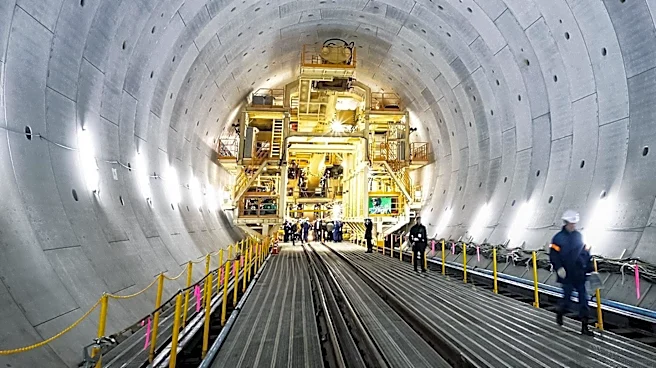
Clifford Milburn Holland, who was named the project's chief engineer in July 1919, devised a twin-tube proposal valued at approximately $28.7 million. The New York and New Jersey Tunnel Commission ultimately rejected Goethals's plan, citing its untested nature, higher cost, and engineering weaknesses that could lead to flooding. Holland also pointed out that Goethals's plan featured narrower road lanes and ventilation ducts that were too small for efficient ventilation. Under Holland's plan, each of the two tubes would have an outside diameter of 29 feet, including exterior linings, and would contain two-lane roadways with a total width of 20 feet. One lane would be for slower traffic and the other for faster traffic. This design was more efficient in terms of excavation, as two 29-foot diameter circles had a combined area of 5,282.2 square feet, less than the 5,541.8 square feet of a single 42-foot diameter circle.
Funding for the ambitious project proved to be another hurdle, as the federal government refused to finance it. Consequently, the responsibility fell to the states of New York and New Jersey. In June 1919, U.S. Senator and former New Jersey governor Edge successfully presented another iteration of the Hudson River Tunnel bill to the U.S. Senate. By September 1919, the New York and New Jersey governments signed a contract, agreeing to build, operate, and maintain the tunnel in partnership. This contract was officially signed by the states' respective tunnel commissions in January 1920, paving the way for construction to begin.
The Start of Construction and Early Obstacles
The official groundbreaking for the Hudson River Tunnel's ventilation shaft took place on October 12, 1920, at Canal and Washington Streets on the Manhattan side. This marked the formal commencement of construction. However, the project soon faced delays due to concerns over its ventilation system, a critical aspect for a vehicular tunnel. Further complications arose from a dispute over whether the New York City government should contribute to street-widening projects on the New Jersey side. Additionally, disagreements between the New York and New Jersey tunnel commissions regarding which agency would award the contract for building the construction and ventilation shafts caused further holdups. These early challenges underscored the complexity and inter-state coordination required for such a monumental undertaking.