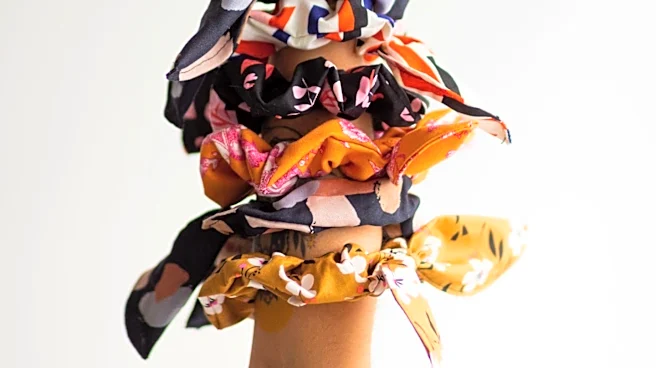







The scrunchie, a fabric-covered elastic hair tie, has a rich history rooted in both practicality and fashion. Designed to secure medium to long hair, this accessory distinguishes itself from a simple elastic band by its loose fabric casing, which forms a distinctive ruffle when twisted around a ponytail. While it experienced peak popularity in the 1980s and 1990s, and again in the mid-2010s, its origins trace back to the mid-20th century with various
individuals contributing to its development and eventual widespread recognition.
Early Concepts and Precursors
The idea of an elastic band covered in fabric wasn't entirely new when the scrunchie as we know it emerged. In 1963, Philips E. Meyers conceived of a fabric-covered elastic band, later filing a patent in 1986 for a "Hair Braiding and Tying Device" related to hair accessories. This early conceptualization laid some groundwork for what was to come. Concurrently, in the early 1980s, Colleen Larkin developed and sold elastic-band-covered fabric products under the name "Ribbonbands." These were distributed nationally across 40 U.S. states and sold in prominent stores like Macy's and Neiman Marcus between 1980 and 1984. During the same period in California, The Body Shop also created and marketed similar ponytail holders, which they called "Silkies" and "Stretchies," echoing the "Ribbonbands" design.
These early iterations demonstrate a growing interest in hair accessories that offered a softer alternative to traditional elastic or metal hair ties. The market was clearly ready for an innovation that combined functionality with a more aesthetically pleasing and gentle design. The groundwork laid by these pioneers set the stage for the scrunchie's formal invention and subsequent rise to fame.
Rommy Hunt Revson's Patent and the Birth of the "Scunci"
The definitive moment for the scrunchie arrived in 1987 when Rommy Hunt Revson secured the patent for the accessory. Revson's motivation stemmed from a desire for a gentler alternative to the metal hair ties prevalent at the time, which could often damage hair. Her journey to invention began with a practical need and a hands-on approach. While working as a house sitter in the Hamptons, she purchased a $50 sewing machine and taught herself to sew. Within weeks, she developed a working prototype.
Revson drew inspiration from the elastic waistband of her sweatpants for the design. She initially named her decorative hair accessory "Scunci," after her pet toy poodle. However, her post-patent period was largely consumed by legal disputes with both manufacturers and her own lawyers, highlighting the challenges of protecting an innovative design in a competitive market. Despite these hurdles, her invention was poised to become a household name.
From Scunci to Scrunchie: A Genericized Trademark
The name "Scunci" eventually evolved into "scrunchie," a modification that aptly described how the fabric of the accessory bunched up or "scrunched" into a compact form. This term became so widely used that it transitioned into a genericized trademark, meaning the brand name became synonymous with the product itself. Today, the brand Scünci is owned by Conair, a company that produces a wide array of hair products, including scrunchies, hair elastics, hair clips, and hair bands. Their specific scrunchie product is marketed as "The Original Scrunchie."
The scrunchie's popularity soared throughout the 1980s and 1990s, with larger and more elaborate versions becoming particularly fashionable. After a period of decreased visibility, the scrunchie experienced a significant resurgence in popularity in the mid-2010s, cementing its status as a timeless hair accessory that continues to adapt to changing fashion trends while retaining its fundamental design and function.