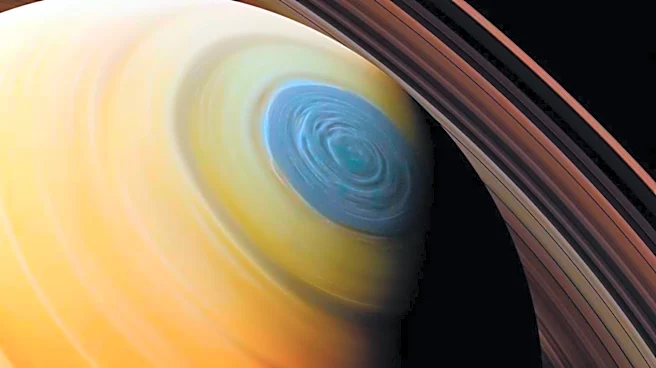








The Cassini space probe, part of the joint Cassini-Huygens mission, spent an unprecedented thirteen years orbiting Saturn, from 2004 to 2017. As the fourth space probe to visit Saturn and the first to enter its orbit, Cassini revolutionized our understanding of the ringed planet, its complex ring system, and its diverse array of moons. Its mission, initially planned for four years, was extended multiple times, allowing for a wealth of discoveries
that reshaped planetary science and provided stunning images of the Saturnian system.
A Prolonged Mission of Discovery
Cassini's primary mission spanned from June 2004 to May 2008. However, its success and the continued scientific value of its observations led to two significant mission extensions. The first, named the Cassini Equinox Mission, lasted for another two years until September 2010. This extension allowed Cassini to observe Saturn during its equinox crossing, a period of unique lighting conditions that offered new perspectives on the planet and its rings. The second and final extension, the Cassini Solstice Mission, continued until the spacecraft's ultimate destruction in September 2017.
Throughout its extended operational life, Cassini conducted numerous flybys of Saturn's moons, gathering data that revealed surprising geological activity, potential subsurface oceans, and complex atmospheric processes. For instance, the probe confirmed the presence of hydrocarbon lakes in Titan's northern polar region in July 2006. It also made close flybys of moons like Enceladus, discovering its atmosphere in March 2005 and later executing a very close flyby at a distance of 175 km in July 2005, which provided crucial data about its geysers.
Key Observations and Scientific Breakthroughs
Cassini's instruments provided a continuous stream of data and images, leading to numerous scientific breakthroughs. Early in its mission, in February 2004, a high-resolution picture of Saturn was released, puzzling scientists with the absence of "spokes" in Saturn's rings, which had been observed by Voyager in 1981. However, by March 2004, pictures confirmed the presence of clumps in the outer "F"-ring, a feature also discovered by Voyager, and Cassini aimed to determine their exact lifetime.
The probe also provided the first "long-term" observations of cloud dynamics in Saturn's atmosphere, revealing high-speed cloud movements and the merging of storms. In April 2004, mission scientists announced the discovery of two new moons, later named Methone and Pallene, orbiting between Mimas and Enceladus. These "shepherd moons" were of particular interest due to their chaotic interactions with the F-ring. Cassini's observations of Titan, starting with its first close-up pictures in July 2004, challenged previous theories, suggesting that icy regions might be darker than areas mixed with organic matter.
The Grand Finale: A Controlled End
As Cassini's fuel supply dwindled, a decision was made to execute a "Grand Finale" phase, culminating in a controlled plunge into Saturn's atmosphere. This final phase, which began in December 2016, involved several risky passes through the gaps between Saturn and its inner rings. The purpose was to maximize the scientific return by gathering unprecedented data from this previously unexplored region, while also preventing any risk of contaminating Saturn's moons, particularly Enceladus, which has active environments that could potentially harbor life.
On September 15, 2017, Cassini made its final dive into Saturn's upper atmosphere, effectively ending its nearly 20-year lifespan, with 13 of those years spent orbiting Saturn. This controlled destruction ensured that the spacecraft, having traveled 7.9 billion km (4.9 billion miles), would not pose a biological contamination threat to any potentially habitable moons. The mission is widely regarded as having succeeded beyond expectations, revolutionizing human understanding of the Saturnian system and leaving an enduring legacy of discovery.