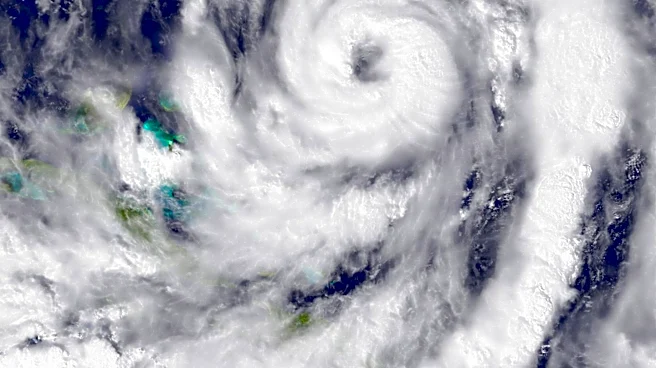









Hurricane Andrew, a name synonymous with catastrophic destruction, carved a path of unprecedented fury across the Atlantic in 1992. This Category 5 storm not only delivered immense physical damage but also set new benchmarks for intensity and financial cost in U.S. hurricane history. Its extreme characteristics, from its powerful winds to the sheer scale of its devastation, cemented its place as one of the most significant natural disasters to strike
the United States. This article explores the record-breaking aspects of Hurricane Andrew, highlighting the sheer force and economic impact that made it a storm for the history books.
A Category 5 Monster: Unmatched Intensity
Hurricane Andrew stands as one of only four tropical cyclones to make landfall in the continental United States as a Category 5 hurricane. This puts it in an elite and destructive class alongside the 1935 Labor Day hurricane, Hurricane Camille in 1969, and Michael in 2018. The storm's intensity was particularly evident in South Florida, where it made landfall with 1-minute sustained wind speeds as high as 165 mph (266 km/h) and gusts reaching 177 mph (285 km/h). A wind gust of 177 mph (285 km/h) was specifically observed at a house in Perrine, Florida, underscoring the extreme forces unleashed by Andrew.With a barometric pressure of 922 hPa (27.23 inHg) at the time of its Florida landfall, Andrew is also recognized as the sixth most-intense hurricane to strike the United States. Post-analysis of the storm revealed that its intensity was often underestimated in real-time. While initially assessed at a peak intensity of 150 mph (240 km/h), this was later upgraded to 155 mph (249 km/h) in a post-storm analysis. Further research in 2004 concluded that Andrew reached maximum sustained winds of 175 mph (282 km/h) near the Bahamas and briefly re-intensified to Category 5 status around its South Florida landfall. This makes Andrew the third-strongest hurricane to hit the U.S. mainland by wind speed, a testament to its formidable power.
Costliest Hurricane in U.S. History (at the time)
Hurricane Andrew was, at the time of its occurrence, the costliest hurricane in U.S. history. It caused an estimated $27.3 billion in damage, which is equivalent to $65 billion in 2023 dollars. This record stood until Hurricane Katrina surpassed it in 2005. In Florida alone, Andrew caused a then-record $25 billion in damage. The storm's impact on structures was immense, destroying more than 63,500 houses and damaging over 124,000 others. The cities of Florida City, Homestead, Cutler Ridge, and parts of Kendall bore the brunt of this destruction, with many homes stripped of all but their concrete foundations.Beyond Florida, Andrew also inflicted significant financial losses. In Louisiana, property losses exceeded $1.5 billion, with 23,000 houses damaged, 985 destroyed, and 1,951 mobile homes demolished. The oil industry in the Gulf of Mexico also suffered, with $500 million in losses for oil companies due to damage to platforms. The widespread nature of the damage, affecting multiple states and various sectors, contributed to its record-breaking cost. The total impact of Andrew included 65 fatalities, further emphasizing the human cost alongside the financial devastation. The name Andrew was retired by the World Meteorological Organization in the spring of 1993 due to the extensive destruction and loss of life, replaced by Alex for the 1998 season, signifying its lasting legacy as a benchmark of hurricane severity.