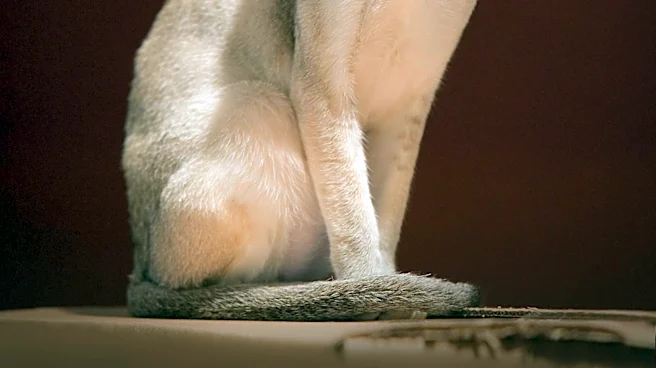








The Singapura, also known as Kucinta in its namesake country, is a distinctive cat breed recognized for its large eyes and ears, a unique ticked coat, and a blunt tail. Many breed associations consider it the lightest and shortest pedigreed cat breed in existence. While initially believed to have originated from three "drain cats" imported from Singapore in the 1970s, its history later revealed a more complex origin. Investigations by the Cat Fanciers'
Association (CFA) ultimately upheld its status as a natural breed, despite revelations that the foundation cats had previously been sent to Singapore from the United States before being re-exported back. This intriguing background has made the Singapura a breed with a story as unique as its appearance.
The Foundation of a Breed
The story of the Singapura breed officially began in 1975 when Tommy and Hal Meadow returned to the United States from Singapore. They brought with them three brown-ticked cats, which they claimed were local Singaporean felines. These three cats—a pair of male and female kittens from the same litter, and another young female—became the foundational stock for the Singapura breed. The breed's name itself is derived from the Malay name for Singapore, reflecting its supposed origins. In 1981, another cat fitting the Singapura profile, though with a slightly different tail, was discovered in a local Society for the Prevention of Cruelty to Animals (SPCA) in Singapore by a breeder. This cat was also imported to the U.S. and integrated into the burgeoning breeding program, further solidifying the breed's genetic base.
The Singapura quickly gained recognition within the cat fancy world. The International Cat Association (TICA) accepted it for registration in 1979, allowing it to compete in championship competitions. The Cat Fanciers' Association (CFA) followed suit, accepting the breed in 1982 and granting it championship status in 1988. During these early years, breeders observed that some litters occasionally produced solid-colored kittens, indicating the presence of a recessive gene for solid color. To ensure the breed consistently produced its distinctive ticked pattern, many breeders undertook test matings to identify and remove individuals carrying this recessive gene from their breeding programs. It was later discovered that two of the original three foundation cats carried this particular gene.
Unraveling the Controversy
The narrative of the Singapura's origin took a controversial turn in 1987. American breeder Gerry Mayes, while on a cat-finding trip in Singapore, uncovered importation papers that contradicted the Meadows' account. These documents indicated that the three foundation cats had actually been brought into Singapore from the U.S. in 1974, a year before the Meadows claimed to have imported them to the U.S. Lucy Koh, a friend of Mayes, attempted to bring this discrepancy to light, but her efforts initially went largely unnoticed. The issue gained significant public attention in 1990 when the Singapore Tourist Promotion Board (now the Singapore Tourism Board) launched a campaign to promote the Singapura as a national mascot. Reporter Sandra Davie was informed of the historical discrepancy and published an article in The Straits Times, a national broadsheet, bringing the controversy into the public eye.
Further fueling speculation, the import certificates listed the cats as Abyssinians. Given that the Meadows had previously bred Abyssinians, Burmese, and Siamese cats, some observers began to theorize that the Singapura might be a cross between a Burmese and an Abyssinian. This theory was even voiced by some CFA judges. The physical resemblance of certain Burmese/Abyssinian crosses to the Singapura, combined with the Singapura's typically small litter size—an uncommon trait for natural breeds—added to the doubts surrounding the Meadows' original story. The CFA launched an investigation at the request of a Singapura breed club. During this inquiry, Hal Meadow provided a new account, stating that the three cats were grandchildren of four local cats he had sent back to the U.S. during a sensitive business trip to Singapore in 1971. This contradicted the Meadows' earlier claims about the foundation cats' direct origin, with Tommy Meadow reportedly having lied to conceal the secret trip.
CFA's Verdict and Ongoing Debate
Despite the conflicting accounts and the revelations, the Cat Fanciers' Association concluded its investigation by finding no wrongdoing and maintained the Singapura's status as a natural breed. Joan Miller of the CFA commented on the situation, stating that "Whether they mated on the streets of Singapore or whether they mated in Michigan, it doesn't really matter." She also highlighted the importance of the cat picked up from the SPCA in 1981, noting that "In addition, there is at least one documented cat that is behind many Singapura pedigrees and it was picked up at the pound. Even with none of the cats the Meadows brought in we still have a legitimate cat from Singapore behind our Singapuras." However, the debate did not entirely subside. Later studies in 2007, based on feline DNA analysis, indicated very few genetic differences between the Singapura and the Burmese, lending further support to the argument that the Singapura might not be a purely natural breed as initially presented.