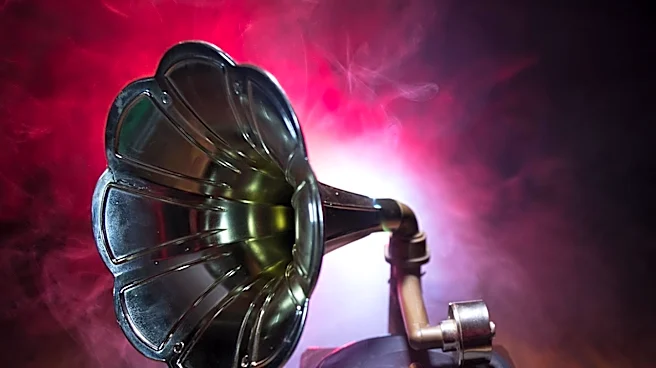









Emile Berliner, born Emil Berliner in Hanover, Germany, on May 20, 1851, was a German-American inventor and businessman whose innovations profoundly influenced the world of sound recording. He is most widely recognized for inventing the lateral-cut flat disc record, commonly known as a "gramophone record," which was designed for use with his gramophone. Berliner's journey from a merchant apprentice in Germany to a pioneering inventor in the United
States highlights a career dedicated to technological advancement, culminating in the founding of the United States Gramophone Company in 1894. His work laid the groundwork for the modern music industry, moving beyond earlier recording methods to establish a more practical and widely adoptable format for recorded sound.
Early Life and Migration to America
Berliner's early life in Hanover was rooted in a Jewish merchant family, where he completed an apprenticeship to become a merchant, following family tradition. However, his true passion lay in invention, a hobby he pursued while working as an accountant to support himself. The political climate of the time, specifically the Franco-Prussian War, prompted a significant change in Berliner's life. To avoid being drafted, he migrated to the United States in 1870. He initially worked in Washington, D.C., in a shop owned by a friend of his father's. This move marked the beginning of his American chapter, where he would eventually become a U.S. citizen and make his most significant contributions.
After his time in Washington, D.C., Berliner moved to New York. There, he took on various temporary jobs, including a paper route and cleaning bottles, to sustain himself while pursuing his intellectual interests. During this period, he dedicated his nights to studying physics at the Cooper Union Institute. This self-directed education in physics proved crucial for his future endeavors in audio technology. His dedication to learning, even amidst financial struggles, underscores his deep commitment to scientific exploration and invention.
Innovations in Audio Technology
Following a period working in a livery stable, Berliner's attention turned to the burgeoning field of audio technology, particularly the telephone and phonograph. His inventive spirit led him to develop an improved telephone transmitter, which was one of the earliest forms of microphones. This invention was significant enough to be acquired by the Bell Telephone Company. However, the patent for this transmitter became the subject of a lengthy legal dispute with Thomas Edison, who also claimed rights to the invention. The United States Court of Appeals ultimately ruled against Berliner on February 27, 1901, declaring his patent void and awarding Edison full rights, stating that "Edison preceded Berliner in the transmission of speech" and that "The use of carbon in a transmitter is, beyond controversy, the invention of Edison."
Despite this legal setback, Berliner's inventive drive remained strong. He moved to Boston in 1877, where he continued his work and became a United States citizen four years later. He worked for Bell Telephone until 1883, after which he returned to Washington, D.C., to establish himself as an independent researcher. It was during this period of private research that Berliner made his most famous invention: the lateral-cut flat disc record and the gramophone to play it. This innovation offered a more durable and easily mass-produced alternative to the cylinder phonographs of the era, fundamentally changing how recorded sound was distributed and consumed. His work with the gramophone and disc record led to the establishment of the United States Gramophone Company in 1894, solidifying his legacy as a pivotal figure in the history of recorded sound.
Beyond Sound: Rotary Engines and Helicopters
Berliner's inventive interests extended beyond sound recording. In 1909, he founded the Gyro Motor Company in Washington, D.C. This company's leadership included Berliner as president, along with Moore as designer and engineer, and Joseph Sanders, an inventor, engineer, and manufacturer. Spencer Heath, a mechanical engineer connected with the American Propeller Manufacturing Company in Baltimore, served as the company's manager. The American Propeller Manufacturing Company was known for producing aeronautical mechanisms and products, indicating Berliner's foray into aviation technology.
By 1910, Berliner was actively experimenting with helicopter designs. A notable aspect of his work in this field was his exploration of using a vertically mounted tail rotor. This component was intended to counteract torque on his single-main-rotor helicopter design. This particular configuration proved to be a significant development, foreshadowing and contributing to the design principles that would lead to the creation of practical helicopters in the 1940s. The building where these operations took place still stands at 774 Girard Street NW, Washington, D.C., with its principal facade located in the Fairmont-Girard area, serving as a tangible reminder of Berliner's diverse and forward-thinking contributions to technology.