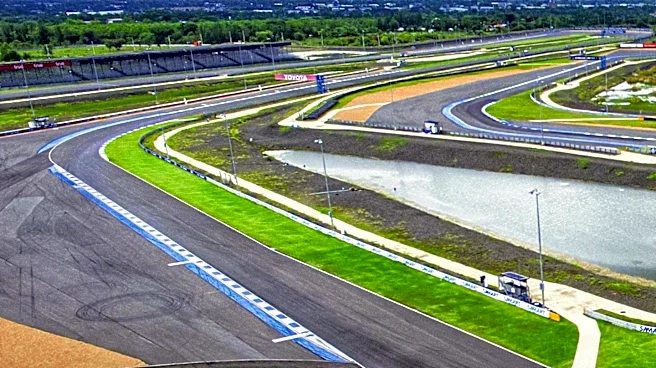



The Monza Circuit, officially known as the Autodromo Nazionale di Monza, has earned its iconic nickname, "the Temple of Speed," due to its distinctive layout characterized by long straights and high-speed corners. This 5.793 km (3.600 mi) race track, situated near Monza, north of Milan, Italy, is not only one of the world's oldest purpose-built motorsport circuits but also a venue renowned for pushing the limits of automotive performance. Its design,
built within the Royal Villa of Monza park, incorporates several unique features that contribute to its legendary status and the thrilling races it hosts.
A Multi-Track Complex
Monza is more than just a single race track; it is a complex featuring three distinct circuits. The primary track is the 5.793 km (3.600 mi) Grand Prix track, which is the most famous and hosts major international events like the Italian Grand Prix. In addition to this, there is a 2.405 km (1.494 mi) Junior track, designed for smaller events and driver development. Perhaps the most historically significant, though largely unused for decades, is the 4.250 km (2.641 mi) high-speed oval track. This oval, with its steep bankings, was left to decay for many years but saw restoration efforts in the 2010s, highlighting its historical importance to the circuit's heritage. The original 1922 design even allowed for the road course and the oval to be used together, alternating laps, with a shared starting straight divided into two lanes.
Signature High-Speed Corners and Straights
The main Grand Prix track is defined by several key features that contribute to its high-speed nature. Among these are the Curva Grande, the Curva di Lesmo, the Variante Ascari, and the Curva Alboreto (formerly known as Curva Parabolica). The Curva Grande, a sweeping, high-speed curve, is located after the Variante del Rettifilo, which itself is at the end of the front straight, or Rettifilo Tribune. This section is typically taken flat out by Formula One cars, showcasing the immense speed capabilities of modern racing machines. The circuit's long straights, combined with these fast corners, demand both powerful engines and precise driving, making it a favorite among speed enthusiasts.
Evolution of the Layout
Over its long history, the Monza Circuit has undergone numerous modifications, often driven by safety concerns. The original layout, particularly the high-speed oval, was the site of several fatal accidents in the early years, including the tragic "Black Day of Monza" in 1933. These events led to significant changes aimed at reducing speeds and improving safety. For instance, in 1934, a shorter circuit was introduced with chicanes and a modified Curva Sud. In 1939, the high-speed oval was demolished, and the road course was extensively rebuilt, including a new central straight and the introduction of the "Curva di Vedano" hairpin turns. While these modifications have continuously aimed to enhance safety and reduce cornering speeds, the circuit has retained its fundamental character as a high-speed challenge. Despite ongoing criticisms from some current drivers regarding the lack of run-off areas, particularly at the chicane cutting the Variante della Roggia, Monza remains a circuit where speed is paramount, offering a unique test for drivers and a thrilling spectacle for fans.