






The Wright Flyer III, constructed by the Wright Brothers during the winter of 1904–05, marked a significant turning point in early aviation. While its predecessors, the Flyer I and Flyer II, laid foundational groundwork, the Flyer III was engineered to be stronger, more durable, and ultimately, more practical. This aircraft represented a crucial phase in the Wrights' journey, moving them from initial inventors to accomplished engineers, as they meticulously
refined their design through a data-driven methodology. The modifications made to the Flyer III addressed critical issues of stability and control, paving the way for more sustained and reliable flights.
Initial Design and Early Challenges
Orville Wright conducted the first flight of the Flyer III on June 23, 1905. Initially, the aircraft bore a strong resemblance to its predecessors and offered similarly marginal performance. It was built with a spruce airframe and featured a wing camber of 1-in-20, a design choice that had been effective in 1903, contrasting with the less effective 1-in-25 used in 1904. The new machine incorporated the engine and other hardware salvaged from the scrapped Flyer II, aiming for improved performance. However, early flights were not without incident.
A serious nose-dive crash on July 14, 1905, resulted in minor injuries for Orville. This incident underscored the persistent stability problems that had plagued earlier models. Rather than deterring them, this setback prompted the Wrights to undertake significant design changes during the rebuilding process. This iterative approach, learning from failures and implementing improvements, was central to their engineering philosophy and would ultimately transform the Flyer III into a much more capable machine.
Major Modifications for Enhanced Performance
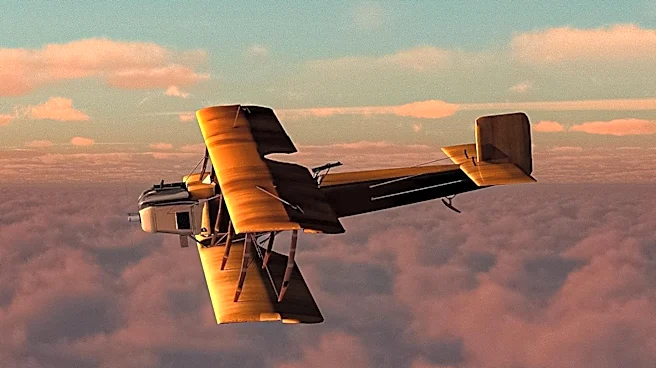
During the rebuilding phase, the Wrights introduced several key modifications to address the Flyer III's shortcomings. They nearly doubled the size of both the elevator and the rudder, and crucially, moved these control surfaces approximately twice the distance from the wings. This repositioning was vital for improving control authority. Additionally, they added two fixed half-moon shaped vertical vanes, referred to as "blinkers," between the elevators, though these were later removed. The skid-undercarriage was also widened, which contributed to giving the wings a very slight dihedral, further enhancing stability.
Beyond these structural changes, the control system itself underwent significant evolution. The rear rudder of the rebuilt Flyer III was disconnected from the wing-warping control, a design decision that would become standard in most future aircraft. It was instead placed on a separate control handle, offering pilots more precise and independent control. To support longer flights, a larger fuel tank was installed, and two radiators were mounted on the front and back struts to provide extra coolant for the engine, anticipating extended operational durations.
Achieving Practical and Dependable Flight
When testing of the Flyer III resumed in September, the improvements were immediately evident. The persistent pitch instability that had hindered Flyers I and II was finally brought under control. The frequent and sometimes severe crashes that characterized earlier testing no longer occurred. Flights with the redesigned aircraft began to last over 20 minutes, a remarkable achievement at the time.
The Flyer III transitioned from an experimental craft to a practical and dependable machine. It demonstrated the ability to fly reliably for significant durations, consistently bringing its pilot back to the starting point safely and landing without damage. A testament to its enhanced capabilities was Wilbur Wright's circling flight on October 5, 1905, covering 24.2 miles (38.9 kilometers) in 39 minutes and 23 seconds over Huffman Prairie. This single flight surpassed the total duration of all flights made in both 1903 and 1904 combined, showcasing the profound impact of the Flyer III's design advancements. This success led the brothers to write to the U.S. War Department on October 19, 1905, proposing to sell the results of their experiments, marking their readiness to transition their invention to a broader application.
The Legacy of the Flyer III
The Wright Flyer III served as a crucial prototype for the later Wright Model A. Its development vividly illustrates the Wrights' data-driven methodology, where observation, experimentation, and systematic modification led to continuous improvement. The journey from the initial, marginally performing Flyer III to its stable and reliable redesigned form highlights their transition from innovative inventors to meticulous engineers. The sculpture of the Wright Flyer III in Dayton, Ohio, a 5,000-pound stainless steel and aluminum model with a 40-foot wingspan, accompanied by bronze statues of the Wright Brothers, stands as a permanent tribute to this pivotal aircraft and the pioneering spirit it represents.