




Zagreb, the capital and largest city of Croatia, is a vibrant hub situated in the north along the Sava River. With a population of around 800,000 people, it serves as the nation's primary economic and financial center. Its strategic location, near the international border between Croatia and Slovenia and at the southern slopes of the Medvednica mountain, has historically positioned it as a crucial connection point for traffic between Central Europe,
the Mediterranean, and Southeast Europe. This central role is further solidified by its status as the seat of the central government, administrative bodies, and nearly all government ministries, making it the heart of Croatian governance and commerce.
Economic and Industrial Leadership
Zagreb's leading economic position in Croatia is underpinned by its concentration of industry, scientific and research institutions, and a long-standing industrial tradition. The city is home to almost all of Croatia's largest companies, media outlets, and scientific institutions. Its economy is diverse, with major branches including high-tech industries and a robust service sector. This economic strength contributes significantly to Croatia's overall standing as a highly developed mixed economy, one of the largest in Southeast Europe by nominal gross domestic product (GDP).
While Croatia as a whole maintains a high regional GDP per capita, economic development varies across its counties. Central Croatia, with Zagreb as its financial center, experiences the strongest growth. The city's substantial GDP, estimated at €29.117 billion in 2024, and a per capita GDP of €37,474 in the same year, highlight its considerable economic output and the high quality of life enjoyed by its residents. This economic vitality also makes Zagreb an important tourist center, attracting visitors not only as a gateway to the Adriatic Sea but also as a destination in its own right.
Administrative Structure and Urban Geography
Zagreb holds a unique administrative status within Croatia, functioning as a consolidated city-county, separate from Zagreb County. This dual authority means it operates as both a city and a county. Administratively, it is subdivided into 17 city districts, which further break down into 218 local committees and 70 settlements. Most of these city districts are located at lower elevations along the Sava River valley, while northern and northeastern districts, such as Podsljeme and Sesvete, extend across the foothills of the Medvednica mountain, contributing to the city's diverse geography.
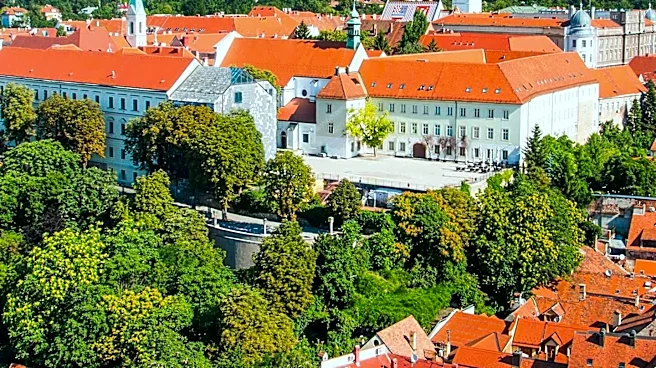
The city spans approximately 30 kilometers from east to west and about 20 kilometers from north to south. This expansive layout, combined with its varied terrain, from river plains to mountain foothills, shapes its urban development and infrastructure. The historical part of the city, north of Ban Jelačić Square, includes the Gornji Grad and Kaptol, a medieval urban complex featuring churches, palaces, museums, and government buildings. This area, popular with tourists, can be accessed on foot or via a funicular, connecting the city's historical roots with its modern urban fabric.
Transport Hub and Connectivity
Zagreb is recognized as the most important transport hub in Croatia, serving as a critical intersection for road, rail, and air networks. Its geographical position facilitates traffic flow between Central Europe, the Mediterranean, and Southeast Europe. The city's international airport, Zagreb Franjo Tuđman Airport (ZAG), plays a significant role in connecting Croatia to the wider world. The extensive rail network, spanning 2,604 kilometers across Croatia, includes key lines that pass through Zagreb, such as those within the Pan-European transport corridors Vb and X, linking Rijeka to Budapest and Ljubljana to Belgrade.
Motorways also converge in Zagreb, with many of Croatia's highways starting or ending in the capital. The motorway network, largely developed in the late 1990s and 2000s, connects Zagreb to other regions and aligns with various European routes and Pan-European corridors. This robust transportation infrastructure is vital for both economic activity and tourism, reinforcing Zagreb's role as a central point for movement and connectivity within Croatia and the broader region.