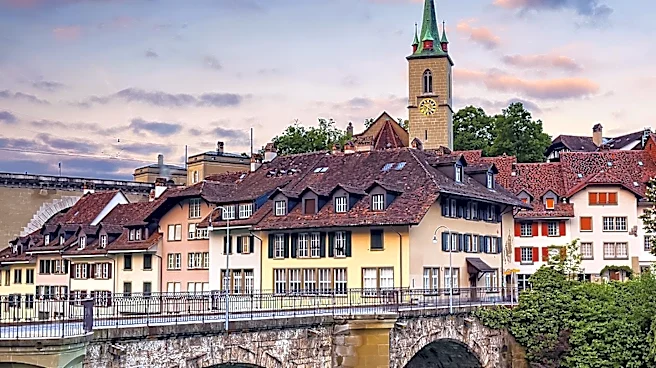




Bern, the capital city of Switzerland, is renowned for its historic Old City, a designated UNESCO World Heritage Site since 1983. This medieval city center, built on a narrow hill bordered on three sides by the Aare River, has maintained its compact layout and essential character since its construction between the twelfth and fifteenth centuries. Despite a significant fire in 1405 that necessitated extensive rebuilding in sandstone, and substantial
construction efforts in the eighteenth century, the Old City has remarkably preserved its medieval charm. Its recognition as a UNESCO site stems from its exceptionally coherent planning concept and its ability to incorporate the modern world while retaining its original medieval core.
The Founding and Early Expansion of Bern
The history of Bern begins with its founding in 1191 by Duke Berchtold V of Zähringen. Local legend suggests the city was named after the first animal the duke encountered on a hunt, which was a bear, influencing both the city's name and its heraldic symbol. At this time, much of what is now Switzerland was under the authority of the House of Zähringen, whose leaders founded or expanded numerous settlements to establish their influence south of the Rhine. Bern's strategic location on a hilly peninsula, bounded by the Aare River, made it easily defensible and shaped its subsequent development into long, parallel rows of houses.
The city's initial expansion likely started at Nydegg Castle and extended to the Zytglogge, or clock tower. This early layout featured three longitudinal streets stretching from the castle to the city wall, with the town church's position and the shape of the eaves being characteristic of a Zähringer city. During the first half of the thirteenth century, two additional streets, Brunngasse and Herrengasse, were added. A wooden bridge over the Aare facilitated increased trade and allowed for limited settlements on the river's east bank, marking the city's gradual growth beyond its initial confines.
Architectural Resilience and Urban Planning
Bern's coherent planning concept and its famous arcades are largely a result of a devastating fire in 1405. This fire, which destroyed most of the city's predominantly wooden buildings, led to a comprehensive rebuilding effort using stone houses in similar medieval styles. The distinctive arcades, which provide covered walkways, were added throughout the fifteenth century as houses expanded their upper stories out into the street. Over the next three centuries, while houses were modified, the fundamental elements of stone construction and arcades remained, contributing to the city's enduring medieval aesthetic.
Beyond the residential structures, the Old City is home to Switzerland's tallest minster, other churches, bridges, and a significant collection of Renaissance fountains. These fountains, many topped with large allegorical statues, were added in the sixteenth century as Bern grew into a powerful and wealthy city-state. They not only provided fresh water but also served as symbols of the city's prosperity. The Old City also houses the seats of the federal, cantonal, and municipal governments, integrating important administrative functions within its historic fabric.
Integrating Modernity into a Medieval Landscape
In the twentieth century, Bern faced the challenge of integrating modern life into its medieval urban environment. While some streets have been preserved as pedestrian zones, the central location and importance of the Old City meant it could not be entirely closed off to vehicles. Major streets accommodate city buses, trams, and personal cars, demonstrating a careful balance between preservation and contemporary needs. The plaza where the Christoffelturm once stood, for instance, has been transformed into the city's central bus stop, with the main train station built beneath it, incorporating some of the tower's original foundations.
One of the most significant projects involved the proposed demolition of the Christoffelturm to open up the city's west end. Following a close vote, the decision to remove the tower and city wall was made in 1864, with the removal completed the following year. This area is now a large road interchange, a major bus station, and the central train station. Despite these modern interventions, many old stone buildings within the Old City have been renovated while preserving their outer appearance, ensuring that Bern's unique medieval character continues to define its urban identity.
Significant Structures and Cultural Heritage
While the entire Old City is a UNESCO World Heritage Site, several individual buildings and fountains hold particular significance and are listed as Swiss Cultural Properties of National Significance. The Münster of Bern, a Protestant Gothic cathedral, began construction in 1421, with its bell tower completed in 1893, making it the tallest church in Switzerland. Its main portal features a rare and complete collection of Gothic sculpture depicting the Last Judgment, and its stained-glass windows from 1441–1450 are considered among the most valuable in Switzerland, including a "Dance of Death" window.
The Untertorbrücke, or Lower Gate bridge, is the oldest bridge in Bern still standing. Originally a wooden walkway from 1256, it was rebuilt in stone after a flood in 1460 and completed by 1490. This bridge was the sole crossing of the Aare near Bern until the construction of the Nydeggbrücke in 1840. Nydegg Church, built on the ruins of Nydegg Castle, also contributes to the Old City's rich history, having served various roles from a church to a warehouse before being reinstated for religious services. These structures collectively underscore the deep historical layers and architectural heritage that make Bern's Old City a remarkable example of a living medieval urban center.