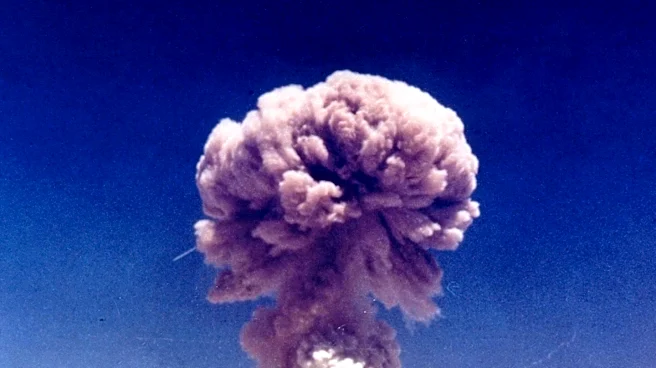









The Nevada Test Site (NTS), a vast expanse of desert and mountainous terrain, served as a primary location for nuclear weapons testing in the United States. While crucial for national defense during the Cold War, the extensive testing conducted there has left a profound and lasting legacy of environmental contamination and significant health concerns for surrounding populations. The site's operations, which included both atmospheric and underground
nuclear detonations, released substantial amounts of radioactive material into the environment, leading to elevated cancer rates and other health issues among those living downwind.
Radioactive Fallout and Public Health
The nuclear tests at the Nevada Test Site generated considerable radioactive fallout, which dispersed across nearby communities. This fallout contained various radionuclides that posed serious health risks. In 1982, a significant lawsuit was filed by nearly 1,200 individuals who accused the government of negligence in its atomic and nuclear weapons testing practices at the site. These plaintiffs alleged that the testing had directly caused leukemia and other forms of cancer among the local population. The concerns were not unfounded, as evidence suggested a link between exposure to this fallout and increased incidences of severe illnesses.Dr. Karl Z. Morgan, who served as the Director of Health Physics at Oak Ridge National Laboratory, provided testimony in this lawsuit. He stated that the radiation protection measures implemented during the tests were substandard when compared to the best practices available at the time. This testimony highlighted a potential failure in safeguarding both the environment and the public from the dangers of radioactive exposure. The long-term consequences of these tests included not only increased cancer rates but also reports of birth defects in the areas surrounding the test site, further underscoring the severe public health impact.
Underground Testing and Groundwater Contamination
Beyond atmospheric tests, a significant number of nuclear detonations at the NTS were conducted underground, some reaching depths of 5,000 feet. Each of these underground explosions vaporized a large chamber, leaving behind a cavity filled with radioactive rubble. A substantial portion of these tests, approximately one-third, were carried out directly within aquifers, while others occurred hundreds or thousands of feet below the water table. This practice introduced radioactive materials directly into the groundwater systems, creating a complex and long-lasting contamination problem.When underground nuclear explosions ceased in 1992, the Department of Energy (DOE) estimated that over 300 megacuries of radioactivity remained in the environment at the site. This made the Nevada Test Site one of the most contaminated locations in the United States. In the most severely affected zones, the concentration of radioactivity in groundwater reached millions of picocuries per liter, dramatically exceeding the federal drinking water standard of 20 picocuries per liter. While radioactivity levels in the water have shown a decline over time, long-lived isotopes such as plutonium and uranium could continue to pose risks for thousands of years, presenting a persistent environmental challenge.
Monitoring and Ongoing Risks
The Department of Energy maintains more than 48 monitoring wells across the Nevada Test Site to track the movement and concentration of contaminants. Despite the high levels of contamination, the DOE has ranked the site as a low priority for clean-up, citing that the contaminated water poses no immediate health threat. However, the detection of tritium, an isotope with a half-life of 12.3 years, in off-site groundwater in Pahute Mesa in 2009, near the locations of the 1968 Benham and 1975 Tybo tests, indicates that contamination can migrate beyond the immediate boundaries of the test site. The DOE continues to issue an annual environmental monitoring report that includes data from both on-site and off-site monitoring wells, providing ongoing insights into the environmental legacy of nuclear testing.The environmental impact extends to the site's ecology as well. Janice C. Beatley began studying the botany of the Nevada Test Site in 1962, establishing 68 study sites. Initially intended to study the effects of radiation on plants, her research shifted after atmospheric testing ceased in 1963. Her sites became crucial for recording long-term ecological changes through 1980, providing valuable data for understanding the enduring effects of the testing on the desert ecosystem.