






New York City stands as a global beacon for culture, finance, and media, a vibrant metropolis located in the Northeastern United States, specifically in southeastern New York State. Comprising five distinct boroughs—Manhattan, Brooklyn, Queens, the Bronx, and Staten Island—the city is a mosaic of diverse experiences and iconic sights. Its influence extends far beyond its geographical boundaries, shaping trends and setting standards across various
fields. From its towering skyscrapers to its bustling cultural venues, New York City offers an unparalleled urban experience that draws millions of visitors and residents alike.
Architectural Marvels Defining the Skyline
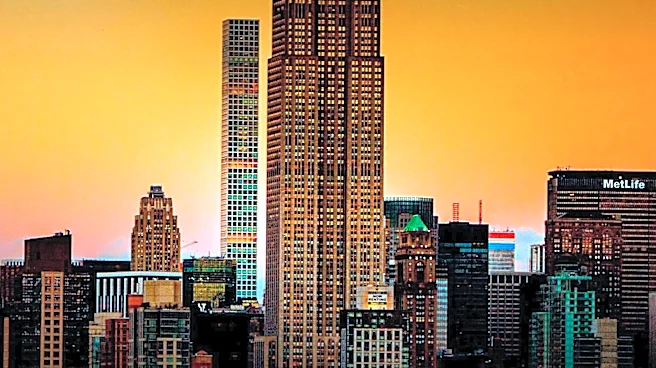
New York City is renowned for its impressive collection of architectural landmarks, with approximately 6,800 buildings boasting more than twelve stories. This makes it a true city of high-rises and skyscrapers. Over one hundred of these structures exceed 200 meters in height; for context, the 109th tallest building, 1 Wall Street, at 202 meters, would be considered among the tallest in Europe. The city's skyline has been continuously shaped by ambitious construction projects, each adding to its unique character and history. Before their destruction on September 11, 2001, the Twin Towers of the World Trade Center were the city's tallest buildings, with the North Tower reaching 417 meters (527 meters with its antenna) and the South Tower 415 meters.
Among the earliest and most distinctive skyscrapers is the Flatiron Building, completed in 1902. Located at the intersection of Broadway, Fifth Avenue, and 23rd Street, this 91-meter-tall structure, designed by Daniel Burnham, was never the city's highest but quickly became a tourist attraction due to its unique triangular footprint, which earned it the nickname "Flatiron Building." Its unusual shape creates strong winds at street level. Despite its current modest height compared to modern giants, its twenty stories were once dominant, and it served as the subject for one of Alfred Stieglitz's most famous photographs shortly after its completion. Another iconic structure is the Chrysler Building on Lexington Avenue, an Art Deco masterpiece completed in 1930. Designed by William Van Alen for automobile manufacturer Walter Percy Chrysler, its gleaming, stepped stainless steel spire with arches and triangular windows reaches 319 meters (282 meters to the roof). For one year, it held the title of the world's tallest building until the Empire State Building was finished.
A Hub of Arts and Entertainment
New York City is a vibrant cultural and artistic center, particularly on the East Coast of the USA, and its influence is felt globally. The city boasts 500 galleries, around 200 museums, and over 150 theaters, alongside numerous department stores and more than 18,000 restaurants. Many of these cultural attractions are concentrated in Manhattan, where skyscrapers in Downtown and Midtown define the urban landscape. The triangular Flatiron Building, opened in 1902, was the city's first skyscraper, followed by others like the Woolworth Building from 1913, the Art Deco Chrysler Building from 1930, and the Rockefeller Center complex, completed in 1939, which includes the NBC studio. The Empire State Building, dating from 1931, is one of the world's most visited monuments, with approximately 3.5 million visitors annually enjoying its observation deck views.
The city's cultural fabric is also enriched by its many churches, such as the Saint Patrick's Cathedral, completed in 1879, and the Cathedral Church of Saint John the Divine, whose construction began in 1892. The Trinity Church at the end of Wall Street, the United Synagogue of Conservative Judaism, and the Armenian Apostolic Church of America Eastern Prelacy also contribute to the city's diverse religious architecture. The Statue of Liberty, erected in 1886 on Liberty Island south of Manhattan, remains New York's most recognizable landmark. Other significant structures include the Grand Central Terminal, the city's main railway station opened in 1913, the Brooklyn Bridge connecting Manhattan and Brooklyn, the Madison Square Garden arena, and Carnegie Hall, a renowned concert venue. The United Nations complex is situated on the East River in Manhattan.
The Enduring Legacy of Broadway and Music
Broadway, centered around Times Square between 41st and 53rd Streets and Sixth and Ninth Avenues, is the heart of New York's theater scene, offering musical performances for every taste. This district houses about 40 large theaters, complemented by approximately 1,500 "Off-Broadway" and "Off-off-Broadway" productions annually in smaller venues. The period between 1910 and 1930 saw a boom in new theater establishments on Broadway. The Lyceum, opened on November 2, 1903, is the oldest continuously operating theater from this era. Originally named the "New Lyceum Theatre" after its predecessor from 1885 was demolished, it was also the first theater to feature electric lighting throughout the entire building, installed by Thomas Alva Edison.
New York is also a pivotal center for music in the United States, alongside Los Angeles, New Orleans, and Chicago. It hosts numerous venues for classical music, including the Metropolitan Opera, as well as countless jazz and rock clubs. Since the late 1920s, New York has been a consistent starting point and hub for various musical developments. Harlem, a predominantly African-American neighborhood, has been a focal point of African-American culture since the 1920s, giving rise to swing, bebop, and free jazz. Disco, punk rock, and new wave are also strongly associated with New York. To this day, New York remains the undisputed "capital" of jazz. Furthermore, the city is the birthplace of hip-hop culture, which has become one of the country's most significant cultural exports and was declared a New York cultural heritage in 2005.