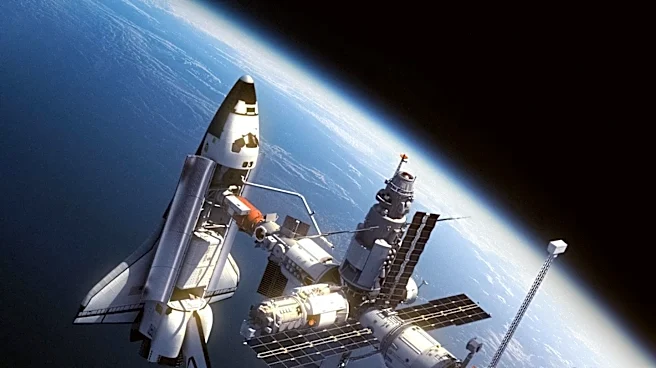





Space Shuttle Atlantis, designated OV-104, played a pivotal role in the Shuttle-Mir program, serving as the primary vehicle for numerous missions to the Russian space station. From 1995 onwards, Atlantis embarked on seven consecutive flights to Mir, facilitating critical crew exchanges, scientific research, and logistical support. Its involvement was instrumental in fostering international cooperation in space and gathering invaluable data for future
endeavors, including the construction of the International Space Station.
Construction and Design Highlights
Atlantis was completed in approximately half the time it took to build its predecessor, Space Shuttle Columbia, showcasing advancements in manufacturing processes. When it rolled out of the Palmdale assembly plant, Atlantis was notably lighter than Columbia, weighing 68,635 kg (151,314 lb). This lighter design contributed to its efficiency and capability for various missions. The orbiter's design incorporated elements of both a rocket and an aircraft, allowing it to launch vertically and then land as a glider, a unique feature of the Space Shuttle fleet.
The orbiter's structure included a three-part fuselage supporting the crew compartment, cargo bay, flight surfaces, and engines. The rear housed the Space Shuttle Main Engines (SSME) for thrust during launch and the Orbital Maneuvering System (OMS) for orbital adjustments. Atlantis was also the first Shuttle to fly with a "glass cockpit" on STS-101, featuring advanced Multifunction Electronic Display System (MEDS) with digital screens, an upgrade that was later implemented across the fleet. This continuous improvement in design and technology ensured Atlantis remained a capable and reliable spacecraft throughout its operational life.
Operational History and Maintenance
Throughout its operational history, Atlantis underwent two significant overhauls known as Orbiter Maintenance Down Periods (OMDPs). The first, OMDP-1, occurred in October 1992 and lasted 20 months. During this period, 165 modifications were made, including the installation of a drag chute, new plumbing for extended duration missions, improved nose wheel steering, and over 800 new heat tiles and blankets. Structural modifications to the airframe and new insulation for the main landing gear were also completed.
OMDP-2 took place from November 1997 to September 1998, involving 130 modifications. These included the integration of glass cockpit displays, replacement of TACAN navigation with GPS, and the installation of an ISS airlock and docking system. Weight reduction efforts were also undertaken, such as replacing Advanced Flexible Reusable Surface Insulation (AFRSI) blankets with lighter FRSI and installing lightweight crew seats. The Extended Duration Orbiter (EDO) package, installed during OMDP-1, was removed to optimize Atlantis for its primary mission of servicing the International Space Station. Even after the Columbia accident, Atlantis received over 75 modifications, ranging from minor bolt change-outs to window replacements and fluid system adjustments, highlighting the continuous effort to enhance its safety and performance.
Atlantis and the Shuttle-Mir Program
Atlantis's contributions to the Shuttle-Mir program were extensive. Beginning with STS-71, it made seven straight flights to the Mir space station. These missions were crucial for the program's objectives, which included joint US-Russian life sciences investigations and logistical resupply of the station. For instance, on STS-74, Atlantis carried a docking module to Mir and delivered water, supplies, equipment, and two new solar arrays to upgrade the station. On STS-76, it rendezvoused with Mir for a crew transfer, and spacewalkers Linda Godwin and Michael Clifford conducted the first U.S. extravehicular activity around the two mated spacecraft. The repeated successful dockings and transfers solidified Atlantis's reputation as a dependable vehicle for international space collaboration.