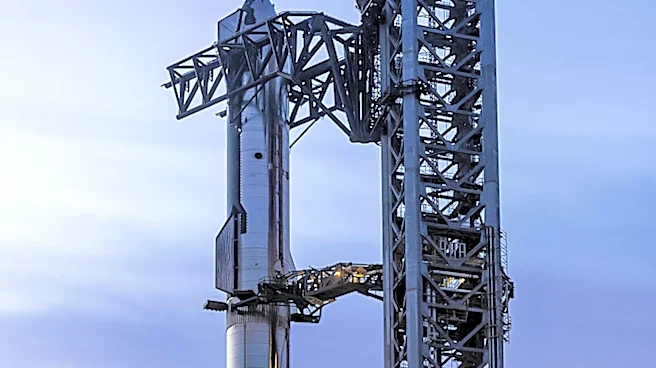







The interstage of the SpaceX Starship Super Heavy booster is not merely a structural connection between stages; it plays a pivotal role in the innovative recovery and ground handling operations of the massive rocket. Central to this function are the protruding hardpoints located on the interstage, which are specifically designed to interface with the launch tower, famously nicknamed "Mechazilla." This system represents a groundbreaking approach to rocket reusability,
aiming to catch and secure the booster directly at the launch site, rather than relying on traditional ocean landings.
Hardpoints and the "Mechazilla" System
The interstage is equipped with robust hardpoints, strategically placed between the grid fins. These hardpoints are critical for both lifting the booster onto the launch pad and, more impressively, for catching it upon its return from space. The launch tower, or "Mechazilla," is designed with mechanical arms that can precisely engage these hardpoints. This capability was first publicly demonstrated on August 23, 2022, when Booster 7 was successfully lifted onto OLM A using these very hardpoints. This event proved the mechanical integrity and operational feasibility of using the interstage for heavy-lift maneuvers. The ultimate test of this system, the first catch of a booster, was achieved on October 13, 2024, with Booster 12, marking a significant milestone in SpaceX's reusability goals.
Grid Fins: Control and Structural Integration
Complementing the hardpoints are the interstage's grid fins. In Block 1 and Block 2 boosters, there were four electrically actuated grid fins, each weighing approximately 3 tons (6,600 lb) and constructed from stainless steel. These fins remain extended during ascent to save weight, though this can lead to mild warping during stage separation. While primarily for aerodynamic control during descent, their placement on the interstage highlights the integrated design philosophy. For Block 3 boosters, the design evolved to three larger grid fins, positioned lower on the vehicle and directly integrated with the catch pins. This integration further emphasizes the interstage's dual role in flight control and ground recovery, with the repositioning aimed at reducing heat exposure during stage separation and the angled grids offsetting asymmetry.
Interstage Evolution for Enhanced Operations
The design of the interstage has continuously evolved to support more complex operations. After the first Starship test flight, all boosters received an additional 1.8-meter (5.9 ft) tall vented interstage. This addition was crucial for enabling "hot staging," a technique where the second stage ignites its engines before fully separating from the first stage. The vented interstage includes a dome to shield the Super Heavy from the second stage's exhaust during this process. While this vented section was initially designed to be jettisoned after the boostback burn on boosters like Booster 11 to reduce descent mass, Block 3 boosters integrate this vented section directly into the vehicle. This continuous refinement of the interstage, from its hardpoints for Mechazilla to its role in hot staging and mass reduction, underscores its central importance in achieving the Starship system's ambitious reusability and performance objectives.