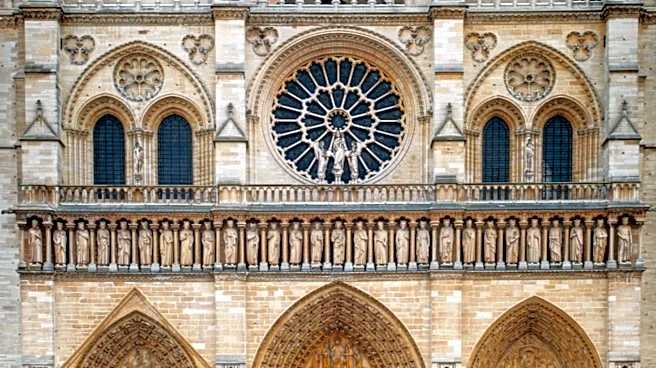







Notre-Dame de Paris stands as a monumental cathedral in the heart of Paris, France, situated on a small island within the River Seine. It is widely recognized as one of France's most celebrated landmarks and serves as a prime example of Gothic Architecture in the country. The cathedral's construction spanned nearly two centuries, from 1163 to 1345, and upon its completion, it held the distinction of being the largest Gothic edifice in Western Europe.
This enduring structure is not only a place of worship for the Catholic Archdiocese of Paris but also a significant historical and cultural touchstone.
Centuries of Construction and Architectural Evolution
The foundation of Notre-Dame de Paris is steeped in history, with tradition suggesting that its first stone was laid in 1163 in the presence of Pope Alexander III. The extensive construction period, lasting from 1163 to 1345, allowed for the development and refinement of its Gothic design. This lengthy timeline contributed to its impressive scale, making it the largest Gothic building in Western Europe at the time of its completion. Its architectural style is distinctly French Gothic, characterized by elements such as its two rose windows, which adorn the transept and are among the largest in Europe, each measuring 13 meters in diameter.
The cathedral's design includes a Latin cross plan, typical of many French cathedrals. Its entrance and two towers face west-northwest, while its apse is oriented east-southeast. The main nave comprises ten bays, and the choir has five. The axis of the choir is slightly deviated from that of the nave. The apse itself is semi-circular with five sides. The interior elevation, excluding the transept, features three levels: large arcades, tribunes, and high windows. However, in the first two bays of both transept arms, the elevation extends to four levels.
Renovations and Enduring Cultural Impact
Between 1844 and 1864, Notre-Dame de Paris underwent significant renovation under the direction of Eugène Viollet-le-Duc. During this period, elements were incorporated into the design that had not been part of the medieval building. For instance, Viollet-le-Duc undertook to "correct" the tenth bay of the nave, recreating the four levels as they appeared before modifications made in the 1220s to the original plan. This deliberate modification has drawn criticism from some specialists, who consider this tenth bay to be largely Viollet-le-Duc's work, though it's noted that only the upper part was transformed.
Beyond its architectural grandeur, Notre-Dame holds a profound cultural significance. It is a UNESCO World Heritage Site and a monument historique, officially named Cathédrale Notre-Dame de Paris. The cathedral is a major tourist attraction, drawing approximately 13 to 14 million visitors annually, making it one of the most visited monuments in Europe. Its fame was further cemented by Victor Hugo's renowned novel, "Notre-Dame de Paris," known in English as "The Hunchback of Notre Dame," which takes place around the cathedral and has been adapted into movies, influencing its public perception and historical narrative.