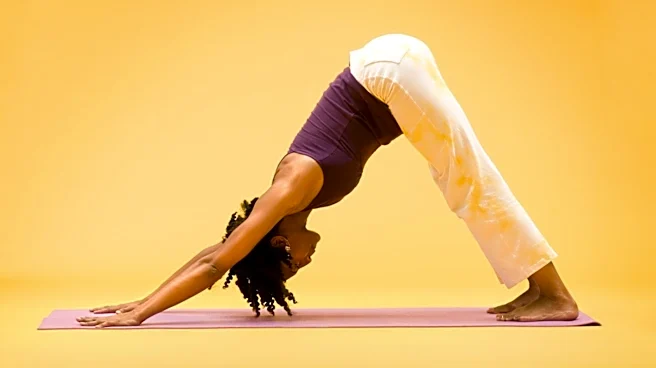


Adho Mukha Svanasana, commonly known as Downward-Facing Dog Pose, is one of the most recognized and frequently practiced postures in yoga. This inverted asana is a staple in many yoga sequences, including the well-known Sūryanamaskāra, or Sun Salutation. Its widespread practice has led to its significant presence not only within yoga communities but also in popular culture and advertising. The pose is characterized by its distinctive shape, resembling
a pyramid with the hips forming the apex and the hands and feet serving as the base, creating an inverted 'V' shape with the body.
The Sanskrit name itself offers insight into the pose: "adho" means "down," "mukha" means "face," "śvāna" means "dog," and "āsana" means "posture" or "seat." This literal translation, "downward-facing dog posture," vividly describes the physical form taken during the practice. While it is a fundamental pose, its execution can vary significantly depending on the specific school or style of yoga, making it adaptable for both beginners and experienced practitioners.
Description and Core Mechanics
The fundamental description of Adho Mukha Svanasana involves placing the head down, with the ultimate goal of the head potentially touching the floor. The body's weight is distributed across the palms of the hands and the soles of the feet. The arms are stretched straight forward, typically positioned shoulder-width apart, while the feet are usually about a foot apart, with the legs kept straight. A key element of the pose is raising the hips as high as possible, which helps to create the inverted 'V' shape.
To achieve this posture, practitioners are encouraged to push their shoulders backward using their hands on the ground, while simultaneously straightening their legs and attempting to keep their heels grounded. It is not always necessary for the entire heel to be on the ground; contact with the toes can be sufficient. The hands are often described as being "rooted" to the floor, providing a stable foundation for the pose. This combination of actions works to stretch the hamstrings and calves, strengthen the arms and legs, and lengthen the spine.
Variations Across Yoga Schools
The approach to entering and performing Adho Mukha Svanasana differs across various yoga traditions. In Iyengar Yoga, for instance, the pose might begin from a prone, or lying face down, position. From there, the hands are placed beside the chest, and the practitioner lifts the hips to establish the distance between the hands and feet. This method emphasizes precise alignment and allows for careful adjustment of the pose.
Conversely, in schools like Sivananda Yoga, the Downward-Facing Dog is often integrated into the Sūryanamaskāra sequence. It typically follows Urdhva Mukha Shvanasana, or Upward-Facing Dog Pose. In this transition, practitioners exhale, curl their toes under, and then raise their hips to move into the Downward-Facing Dog. The Bihar School of Yoga refers to this pose as Parvatasana, or Mountain Pose. In their approach, the hands and feet are positioned somewhat closer to each other, resulting in a sharper angle at the hips. This variation is often entered from a lunge, known as Ashwa Sanchalanasana, within a variant of the Sūryanamaskāra.
Adaptations and Props for Practice
While Downward-Facing Dog is considered a restorative pose for experienced yogis, it can present a challenge for beginners. Fortunately, several variations and props can make the pose more accessible. For those new to the practice or with tight hamstrings, bending the knees slightly is a common modification, which may cause the heels to lift off the floor. The heels can also be supported by placing a rolled-up yoga mat or similar equipment underneath them, providing stability and reducing strain.
Further adaptations include lowering one forearm to the floor while extending the other hand forward, or bending one knee and lowering the hip on that side. Practitioners might also engage in a "pedaling" motion, alternately bending one knee and raising the ankle on that side, then switching to the other leg. Another variation involves raising one leg into the air, either keeping it straight or bending the knee, and flexing and extending the foot. For additional support, props such as a strap attached to a wall anchor around the hips can be used, or a bolster placed under the forehead, sometimes combined with a rolled blanket or towel under the feet. The pose can even be modified by placing the hands on the back of a chair, which brings the back to a more horizontal position and reduces pressure on the shoulders, making it suitable for individuals with shoulder injuries.