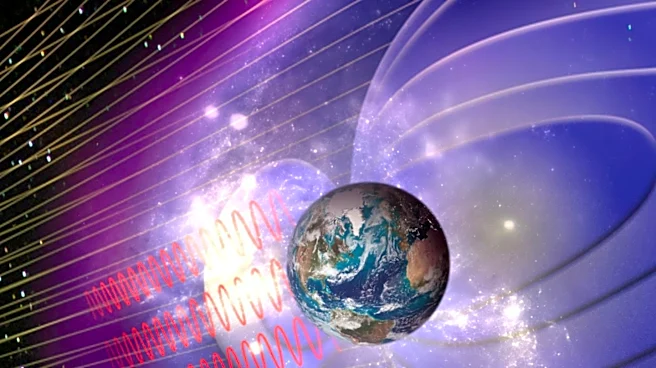



Explorer 4 was a groundbreaking satellite launched by NASA in 1958, designed to study the Earth's radiation belts. This mission was a pivotal moment in space exploration, as it provided the first detailed measurements of charged particles trapped in the Earth's magnetosphere. The data collected by Explorer 4 significantly advanced the scientific community's understanding of space radiation and its effects on the Earth's environment.
Scientific Instruments and Measurements
Explorer 4 was
equipped with a suite of sophisticated instruments designed to measure charged particles in the Earth's radiation belts. The satellite carried four separate radiation detectors, each with specific capabilities. These included a shielded directional plastic scintillation counter, a caesium iodide scintillation counter, and two Geiger-Müller counters. These instruments were sensitive to various energy levels of electrons and protons, allowing for comprehensive data collection.
The detectors were mounted orthogonally to the satellite's longitudinal axis, with apertures facing in opposite directions. This configuration enabled the satellite to capture a wide range of data as it orbited the Earth. The information gathered by these instruments was crucial for understanding the behavior of charged particles in the Earth's magnetosphere and their potential impact on space missions and satellite operations.
Contributions to Nuclear Test Analysis
In addition to studying natural radiation belts, Explorer 4 played a critical role in analyzing the effects of nuclear tests conducted in space. The satellite's telemetry was used to observe the impact of three high-altitude nuclear detonations, known as Operation Argus, conducted between August 27 and September 6, 1958. These tests were designed to study the effects of nuclear explosions on the Earth's magnetosphere and radiation belts.
The data collected by Explorer 4 during these tests provided valuable insights into the behavior of artificially injected electrons and their interactions with the Earth's magnetic field. This information was essential for understanding the potential risks associated with nuclear explosions in space and their impact on satellite operations and communication systems.
Legacy and Impact
Despite facing challenges such as an unexpected tumbling motion and equipment failures, Explorer 4's mission was a success. The satellite provided critical data that advanced the scientific understanding of space radiation and its effects on the Earth's environment. The information gathered by Explorer 4 laid the foundation for future research and exploration, influencing the design and operation of subsequent space missions.
Explorer 4's contributions to space radiation research continue to be recognized as a significant milestone in the history of space exploration. The mission's success demonstrated the importance of studying the Earth's radiation belts and their impact on space activities, paving the way for future advancements in space science and technology.