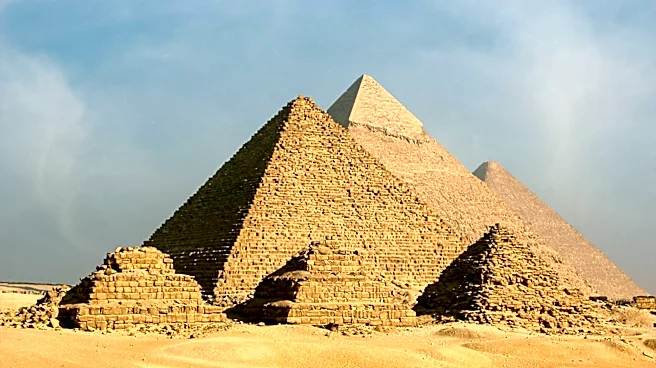






The Giza pyramid complex is a monumental testament to the power and religious convictions of the pharaohs of ancient Egypt's Fourth Dynasty. Each of the three main pyramids—the Great Pyramid, the Pyramid of Khafre, and the Pyramid of Menkaure—was commissioned by a specific pharaoh, creating a dynastic legacy etched in stone. These structures were not merely tombs but elaborate complexes designed to ensure the pharaoh's successful journey into the afterlife
and their continued connection to the divine.
Khufu: The Great Pyramid and Its Complex
Pharaoh Khufu, also known as Cheops, initiated the construction of the Great Pyramid, the largest and oldest of the Giza pyramids, between approximately 2580 and 2560 BC. His pyramid complex was extensive, though much of it is now buried or destroyed. It included a valley temple, which is currently beneath the village of Nazlet el-Samman. While the site has not been fully excavated, evidence of diabase paving and nummulitic limestone walls has been found. This valley temple was connected by a causeway to the Mortuary Temple of Khufu, of which only the basalt pavement remains today. The causeway itself was largely destroyed during the construction of the village.
Associated with Khufu's pyramid are three smaller queens' pyramids (G1-a, G1-b, and G1-c) and three boat pits. These boat pits held actual ships, with two on the south side of the pyramid containing intact vessels when excavated. One of these, the Khufu ship, has been restored and was initially displayed at the Giza Solar Boat Museum before being moved to the Grand Egyptian Museum. These elements underscore the comprehensive nature of Khufu's burial complex, designed to provide everything necessary for his eternal journey.
Khafre: The Second Pyramid and the Sphinx
Following Khufu, his son Khafre (also known as Chephren) commissioned the second pyramid at Giza. Built a few hundred meters southwest of the Great Pyramid, Khafre's pyramid appears larger due to its more elevated location and steeper angle of inclination, though it is actually smaller in both height and volume. A distinctive feature of Khafre's pyramid is the prominent display of casing stones that remain at its apex. The consensus among Egyptologists is that the head of the Great Sphinx, which lies on the east side of the complex, is that of Khafre, further linking him to this iconic monument.
Khafre's pyramid complex was equally elaborate, comprising a valley temple, the Sphinx temple, a causeway, a mortuary temple, and the king's pyramid itself. The valley temple was particularly rich in artifacts, yielding several statues of Khafre. Many of these were discovered in a well within the temple floor by Mariette in 1860, with others found during subsequent excavations by Sieglin, Junker, Reisner, and Hassan. His complex also included five boat-pits and a subsidiary pyramid with a serdab, indicating a similar dedication to providing for the pharaoh's afterlife as seen in his father's complex.
Menkaure: The Smallest Pyramid and Its Statues
The final major pyramid at Giza was built for Menkaure (also known as Mykerinos), Khafre's son, located a few hundred meters farther southwest. Menkaure's pyramid is relatively modest in size compared to its predecessors and is the only one of the four major monuments seen today without any of its original polished limestone casing. His pyramid complex included a valley temple, a causeway, a mortuary temple, and the king's pyramid, which was completed around 2510 BC. The valley temple once housed several statues of Menkaure, and a smaller ante-temple was added to it during the 5th Dynasty. The mortuary temple also yielded multiple statues of the pharaoh. Menkaure's pyramid is accompanied by three subsidiary, or queen's, pyramids, completing the dynastic arrangement of the Giza necropolis. These complexes collectively represent a profound expression of royal power, religious belief, and architectural ambition across generations of pharaohs.