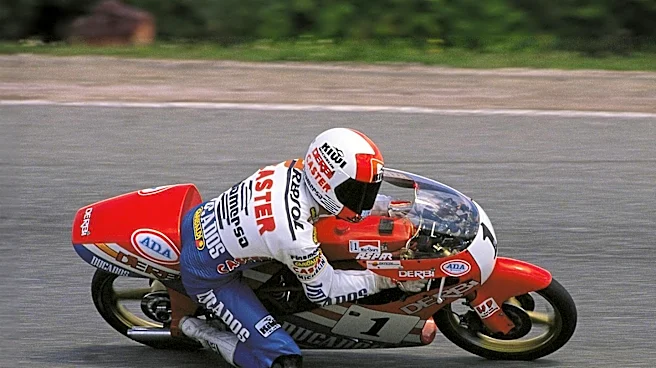





Motorcycle road racing, a thrilling form of motorsport, has undergone significant transformations since its inception. What began as competitions on public roads has evolved into a highly organized global championship, Grand Prix motorcycle racing, governed by the Fédération Internationale de Motocyclisme (FIM). This journey has been marked by continuous efforts to enhance safety for both riders and spectators, leading to the transition from dangerous
street circuits to purpose-built closed-circuit tracks. The sport's history is also characterized by the evolution of motorcycle classes, adapting to technological advancements and changing safety standards.
Early Days and the Shift to Closed Circuits
Originally, motorcycle road races were held almost entirely on public roads. This practice, while perhaps offering a raw and accessible form of racing, presented considerable hazards. The inherent dangers of racing at high speeds on public thoroughfares, often with minimal safety infrastructure, became increasingly apparent as speeds increased. This led to a crucial shift in the sport's development. To increase safety, road races were largely moved to closed-circuit tracks.
This move was a pivotal moment, recognizing the need for controlled environments where safety measures could be systematically implemented. The early post-World War I era saw a divergence in racing paths between Europe and North America. While American automobile and motorcycle racing often gravitated towards oval tracks like the Indianapolis Motor Speedway or dirt tracks, European road racing began its transition towards more dedicated circuits. The FIM officially introduced the Grand Prix motorcycle racing world championship in 1949, with the Isle of Man TT serving as the inaugural event. Initially, with the exception of the Monza circuit, all Grand Prix races were still held on street circuits, underscoring the gradual nature of this transition.
Racing Hazards and the Drive for Safety Improvements
Tragic incidents played a significant role in highlighting the urgent need for improved safety in road racing. The 1955 Le Mans disaster, though an automobile race, underscored the dangers of spectators being too close to the circuit. In this event, two race cars collided, causing one to crash into an embankment, explode, and plow through the crowd, resulting in 83 spectator fatalities and 120 injuries, in addition to the driver's death. This catastrophe led to temporary bans on auto racing in several countries until spectator safety was enhanced. Switzerland, for instance, did not allow circuit racing again until 2018, with an exemption for Formula E, and only legalized Swiss Motorsport in 2026.
Motorcycle racing also faced its share of tragedies. The 1961 Italian Grand Prix at Monza saw driver Wolfgang von Trips lose control of his Ferrari, crashing into a stand of spectators and killing 15 people along with himself. The continuing risks were further emphasized when Jochen Rindt posthumously won the Formula One drivers' championship in 1970. These events highlighted the critical need for better safety standards for both competitors and the audience, an issue that remained prominent throughout the 1960s and 1970s.
Motorcycle-Specific Safety Concerns and Class Evolution
Motorcycle racing presented unique safety challenges. The death of Gilberto Parlotti at the 1972 Isle of Man TT led to a rider boycott, spearheaded by multi-time world champion Giacomo Agostini. This pressure eventually resulted in the Isle of Man TT losing its world championship status in 1976 due to demands for increased safety. Another incident at Monza during the 1973 Italian motorcycle Grand Prix claimed the lives of world champion Jarno Saarinen and Renzo Pasolini. Ironically, after the 1961 von Trips accident, the Monza Circuit had been lined with steel barriers, a measure intended to improve safety for auto racers. However, these barriers proved fatal for motorcyclists, demonstrating that safety solutions for one form of racing might not be suitable for another.
The dangers of street circuits were further exposed at the 1975 Spanish Grand Prix on the Montjuich circuit in Barcelona. Drivers found the safety barriers shoddily installed and threatened to strike. The race proceeded under pressure but was stopped after 29 laps when a car plowed into the crowd, killing four spectators. These incidents collectively pushed the sport towards more rigorous safety protocols and purpose-built tracks.
Modern Grand Prix Classes and Technical Regulations
Grand Prix motorcycle racing, the premier championship, has seen its classes evolve significantly over time. When the championship began in 1949, there were five classes: 500cc, 350cc, 250cc, 125cc, and sidecar. The 50cc class was introduced in 1962. Throughout the 1960s, two-stroke engines began to dominate the smaller classes, replacing the four-stroke engines that had been prevalent. In 1969, the FIM introduced new rules to curb high development costs, restricting cylinders and gears, which led to a temporary walk-out by major manufacturers like Honda, Suzuki, and Yamaha.
By the mid-1970s, two-strokes had completely eclipsed four-strokes. The top class, 500cc, allowed a maximum of four cylinders for both two-stroke and four-stroke engines, but two-strokes were universally preferred due to their power delivery. In 2002, significant rule changes were implemented to phase out the 500cc two-strokes. The premier class was rebranded MotoGP, allowing manufacturers to choose between 500cc two-strokes or four-strokes up to 990cc. Despite higher costs, the four-stroke engines quickly dominated, and by 2003, no two-stroke machines remained in MotoGP. The 125cc and 250cc classes continued to use two-stroke machines for a longer period.
Further changes occurred in the 21st century. In 2007, the MotoGP engine displacement was reduced to 800cc. The 2010 season saw the 250cc two-stroke class replaced by the new Moto2 600cc four-stroke class. In 2012, the 125cc two-stroke class was replaced by the Moto3 250cc four-stroke class. The MotoGP engine capacity was increased again to 1,000cc for the 2012 season. More recently, MotoE, an electric motorcycle class, was introduced in 2019 as a World Cup and gained World Championship status from 2023 to 2025. These continuous adjustments reflect the sport's ongoing commitment to balancing performance, innovation, and safety.