






Siem Reap, the second-largest city in Cambodia and the capital of Siem Reap Province, holds a name deeply rooted in centuries of conflict between the Siamese and Khmer kingdoms. While today it is a major tourism hub, its very name, which translates to 'defeat of Siam,' serves as a historical marker of past struggles. This historical narrative, though sometimes considered apocryphal by scholars, is a cornerstone of the city's identity and reflects
a long period of regional power dynamics.
Ancient Origins and Early Endowments
During the Angkor period, Siem Reap was known as Dvijendrapura, a town whose ancient site is likely marked by the old temple of Prah Einkosei. Inscriptions from Prah Einkosei, dating to 968 and 970 CE, provide a glimpse into the religious life of the time. These inscriptions, written in both Sanskrit and Old Khmer, detail religious endowments made by Princess Indralakshmi, daughter of Rajendravarman II, and her husband Divakara-bhatbhat. These endowments included an image of Vishnu named Dvijendra and an ashrama. They also established a temple in a place called Madhuvana, which scholars identify with present-day Prasat Komphus near Phnom Sandak. Further inscriptions at Prasat Komphus indicate that the temples at Dvijendrapura and Madhuvana shared property, signifying a close connection between these sacred territories.
The Legend of 'Defeat of Siam'
According to a widely held oral tradition, the name "Siem Reap" was bestowed by King Ang Chan I (1516–1566) after a significant victory. The tale recounts that in 1549, King Ang Chan I repulsed an invading army sent by the Thai king Maha Chakkraphat. This event, where the Khmer forces allegedly defeated the Siamese, led to the naming of the battleground as "Siem Reap," meaning 'the total defeat of Siam.' However, some scholars, like Michael Vickery, view this derivation as a modern folk etymology, suggesting that the actual origin of the name remains unknown, though it might be related to the old Chinese name for Cambodia, Chenla.
A Deeper Look into the Conflict
The traditional story elaborates on the circumstances leading to King Ang Chan's victory. It suggests that King Ang Chan sought greater independence from Siam during a period of internal turmoil within the Siamese kingdom. The Siamese king Chairacha had been poisoned, and his concubine, Lady Sri Sudachan, had placed her lover, Worawongsathirat, on the throne. The Thai nobility, however, orchestrated a plot, luring the usurper and Sudachan outside the city and subsequently killing them. Prince Thianracha was then invited to become King Maha Chakkraphat (1548–1569).
While Siam was preoccupied with these internal power struggles, King Ang Chan seized the opportunity to attack. In 1549, he captured and sacked the Siamese city of Prachinburi, taking its inhabitants as slaves. Upon learning that Maha Chakkraphat had ascended to the throne, Ang Chan retreated to Cambodia with his captives. Maha Chakkraphat, angered by the unprovoked attack and Ang Chan's refusal to provide a white elephant as a token of submission, ordered an expedition led by Prince Ong to punish Ang Chan. However, during the ensuing battle, King Ang Chan reportedly killed Prince Ong with a musket shot from an elephant's back. The leaderless Thai army fled, and Ang Chan allegedly captured over 10,000 Siamese soldiers, leading to the celebratory naming of Siem Reap.
Historical Realities and Shifting Control
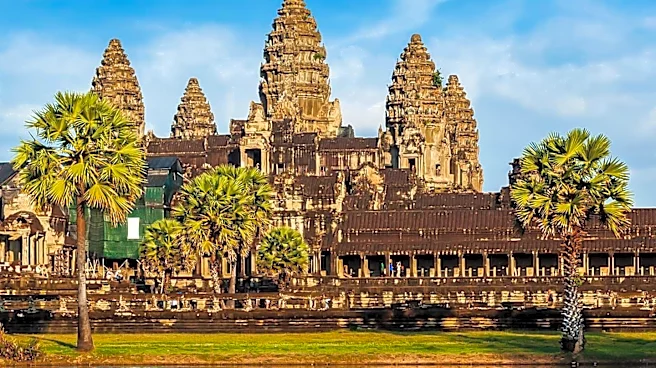
Despite the vivid oral tradition, surviving historical sources suggest that the decline of Angkor predates this alleged victory by more than a century. The capture and sacking of Angkor Wat by a military expedition from Ayutthaya in 1431 marked the beginning of a long period of vassal rule over Cambodia. The reasons for Angkor's abandonment are complex, possibly involving environmental changes and failures in Khmer infrastructure. From the 16th to the 19th centuries, internal conflicts among the Khmer nobility led to interventions and domination by both Vietnam and Siam. Siem Reap, along with Battambang and Sisophon, was under Siamese administration as part of Inner Cambodia from 1795 until 1907, when these territories were ceded to French Indochina. This period of shifting control further underscores the long and often turbulent history that shaped the region and the city of Siem Reap.