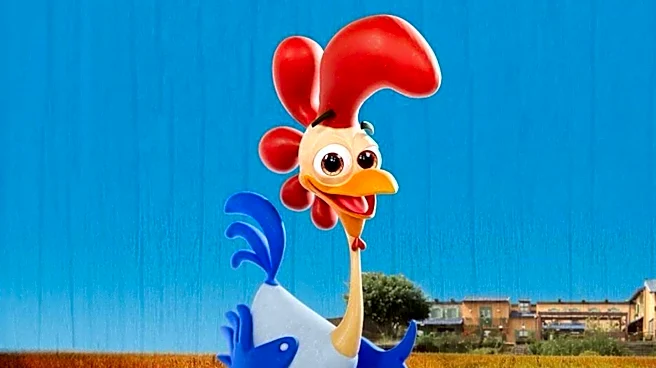

"Walky Talky Hawky," a 1946 Warner Bros. Merrie Melodies theatrical short, holds a significant place in animation history as the debut vehicle for the iconic character Foghorn Leghorn. Directed by Robert McKimson, this short not only introduced the boisterous rooster but also featured Henery Hawk, who had previously appeared in a 1942 short. The film established the dynamic between these characters, laying the groundwork for many future Looney Tunes
adventures and cementing Foghorn Leghorn's place in popular culture.
The Genesis of a Rooster
Foghorn Leghorn's first appearance in "Walky Talky Hawky" marked the beginning of a long and successful run for the character. He was created by Robert McKimson, who would go on to direct all 29 of Foghorn's cartoons from 1946 to 1964 during the golden age of American animation. This initial short immediately showcased Foghorn's distinctive personality: a large, anthropomorphic rooster with a Southern accent and a penchant for mischief. His voice, created and originally performed by Mel Blanc, became an integral part of his character, contributing to his memorable presence from the very start.
In "Walky Talky Hawky," Foghorn's role is central to the plot, as he manipulates the young Henery Hawk. Seeing Henery as a potential pawn in his ongoing prank war with the Barnyard Dawg, Foghorn convinces the naive chicken hawk that he is a horse and that the Dawg is, in fact, a chicken. This early display of Foghorn's cunning and his tendency to instigate conflict set the tone for his character in subsequent cartoons. The short effectively introduced his bombastic nature and his talent for orchestrating elaborate pranks.
Establishing Key Rivalries and Character Dynamics
The short also played a crucial role in establishing the foundational rivalries that would define many Looney Tunes cartoons. The perennial prank war between Foghorn Leghorn and the Barnyard Dawg is a central element of "Walky Talky Hawky." While the short doesn't reveal how or why their feud began, it clearly depicts Foghorn as the initial aggressor, pranking the Dawg out of sheer self-amusement. This dynamic, where Foghorn often initiates the conflict, became a recurring theme in their interactions.
Furthermore, the film introduces the complex relationship between Foghorn and Henery Hawk. Henery, a small, brown chickenhawk, is eager to capture a chicken but, having led a sheltered life, doesn't know what one looks like. Foghorn exploits this naivety, pointing Henery in the direction of the Barnyard Dawg. This manipulation leads to a series of mishaps for the Dawg, orchestrated by Foghorn. The cartoon culminates with Henery realizing he's been tricked, leading him to turn on Foghorn. This early interaction highlights Foghorn's role as a mentor figure, albeit a mischievous one, to younger characters, a trait that would be further explored in later shorts.
A Lasting Legacy in Animation
"Walky Talky Hawky" not only served as Foghorn Leghorn's debut but also marked the first cartoon roles for both Foghorn and the Barnyard Dawg. Henery Hawk, while having appeared once before, found a significant recurring role in this short and its successors. The film's narrative structure, involving Foghorn's elaborate schemes and the resulting chaos, became a blueprint for many subsequent cartoons featuring these characters. The short's success helped solidify the comedic potential of these interactions, ensuring that Foghorn Leghorn, with his distinctive voice and personality, would become a beloved and enduring figure in the Looney Tunes universe. His catchphrases and boisterous demeanor, first showcased in this 1946 short, continue to resonate with audiences.