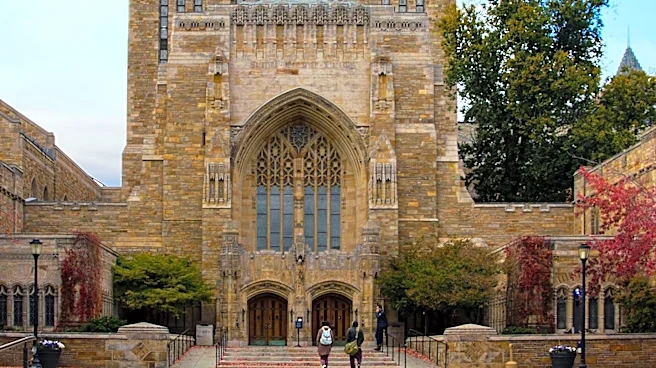








Yale University, one of the oldest and most prestigious institutions in the United States, began its journey in 1701 as the Collegiate School. Established by Congregationalist clergy of the Connecticut Colony, its initial focus was primarily on theology and sacred languages. Over centuries, this foundational institution underwent significant transformations, expanding its curriculum, organizational structure, and societal role to become the comprehensive
research university it is known as today. Its evolution reflects broader changes in American higher education, from a seminary-like college to a leading center for diverse academic pursuits and scientific inquiry.
Early Foundations and Curriculum Expansion
The Collegiate School, as Yale was first known, opened in the home of its first rector, Abraham Pierson, in Killingworth. In 1702, Nathaniel Chauncey became the first person to earn a degree, which was conferred through an oral examination. The school later moved to Saybrook in 1707 after Nathaniel Lynde, Yale's first treasurer, donated land and a building. Despite a deed requiring it to stay in Saybrook, trustees voted in 1716 to relocate the school to New Haven, which had successfully outbid other communities.
By the time of the American Revolution, the school's curriculum had already begun to broaden, incorporating humanities and sciences alongside its theological core. This expansion was influenced by the intellectual movements of the period, such as the Great Awakening and the Enlightenment, driven by presidents like Thomas Clap and Ezra Stiles. These leaders were instrumental in developing the scientific curriculum, even while navigating challenges like wars, student unrest, and financial needs. A significant event in this early period was the 1714 shipment of 500 books donated by 180 prominent intellectuals in England, which profoundly impacted Yale's intellectual environment, introducing works by figures like John Locke and fostering new theological discussions.
Nineteenth-Century Growth and University Status
The 19th century marked a period of significant expansion for Yale. The college began to include graduate and professional instruction, a crucial step towards its future as a university. In 1861, Yale awarded the first PhD in the United States, a testament to its growing commitment to advanced research and scholarship. This academic growth culminated in 1887 when the institution officially organized as a university and was renamed "Yale University" by an act passed by the Connecticut General Assembly. Prior to this, its legal name had been "The President and Fellows of Yale College, in New Haven."
During this era, Yale also saw the rise of private student societies, such as Crotonia (1738), Linonia (1753), and Brothers in Unity (1768). These invitation-only forums served as venues for discussions on scholarship, literature, and politics, reflecting a vibrant intellectual and social life beyond formal coursework. As the only college in Connecticut from 1701 to 1823, Yale educated the sons of the elite, and its early student body was characterized by a focus on classical languages, including Hebrew, which President Ezra Stiles championed for studying ancient Biblical texts.
Twentieth and Twenty-First Century Developments
The 20th century brought rapid growth in Yale's faculty and student populations, largely due to the expansion of its physical campus and scientific research programs after 1890. The university became a founding member of the Association of American Universities, solidifying its role as a leading research institution. Notable developments included the establishment of the Yale School of Medicine, which saw significant advancements under Dean Milton Winternitz from 1920 to 1935, and the introduction of co-education in 1969, with the class of 1973 being the first to include women from freshman year.
In the 21st century, Yale continues to evolve. In 2007, the university acquired the 137-acre former Bayer campus in West Haven and Orange, Connecticut, establishing the Yale West Campus to focus on biotechnology, pharmaceuticals, and other life sciences research. Yale's commitment to excellence in undergraduate education and the education of leaders remains a core institutional priority. The university is classified among "R1: Doctoral Universities—Very high research activity" and was ranked 16th among American universities for research and development expenditures in 2024, with $1.52 billion, underscoring its ongoing dedication to cutting-edge research and academic leadership.