




James Cook's three voyages across the Pacific Ocean brought Europeans into contact with numerous indigenous cultures, many of whom had little or no prior interaction with outsiders. These encounters were often complex, characterized by initial curiosity, ceremonial exchanges, and significant cultural learning, but also by profound misunderstandings that sometimes escalated into violence. Cook's instructions from the Admiralty emphasized cultivating
friendships and treating indigenous peoples with civility, yet the realities of exploration, resource acquisition, and differing cultural norms frequently led to friction. From the initial reverence shown by Hawaiians who believed him to be a god, to the tragic conflict that led to his death, Cook's interactions with Pacific peoples reveal a nuanced history of cross-cultural exchange and its inherent challenges.
Initial Receptions and Perceptions of Divinity
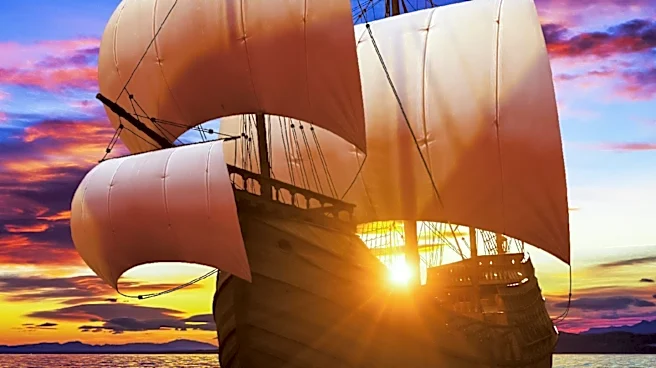
Upon his first recorded visit to the Hawaiian Islands on January 18, 1778, Cook and his crew were met with remarkable deference. When he first stepped ashore, Hawaiians prostrated themselves before him, a gesture typically reserved for their highest chiefs. This initial reception set a tone of awe and respect. During his second visit to Hawaii in late 1778, this perception deepened significantly. Many Hawaiians came to believe that Cook was an embodiment of the Polynesian god Lono. This belief was partly due to the timing and manner of his arrival, which coincided with the Makahiki, a Hawaiian harvest festival dedicated to Lono. Some scholars suggest that the form of Cook's ship, HMS Resolution, with its mast formation, sails, and rigging, resembled significant artifacts central to the season of worship, further reinforcing this divine association.This perception of Cook as a deity or high-ranking spiritual figure was not unique to Hawaii. In various parts of Polynesia, Cook was considered an *ariki* (high chief), and thus an embodiment of the powers and attributes of certain *atua* (Polynesian gods). His status as an *ariki* stemmed from his leadership role, the deference shown to him by his crew, the power of the weapons he commanded, and the respect he gained through ceremonial friendships with local chiefs. These friendships often involved exchanging genealogies, names, and symbols of status, merging their ancestries and *mana* (life force). Such initial receptions highlight the profound cultural differences and the ways in which indigenous peoples attempted to integrate these new, powerful visitors into their existing worldviews.
Cultural Exchanges and Mutual Learning
Despite the eventual conflicts, Cook's expeditions facilitated considerable cultural exchanges. Several members of his crew learned to speak Polynesian languages, and Polynesian words such as *tabu* (taboo) and *tatu* (tattoo) entered the English language. Polynesians, in turn, learned some English, with individuals like Tupaia and Mai becoming quite proficient. The term "Cookees" even became a Tahitian word for Europeans. Both sides adopted new foods; Cook's crew developed a taste for local Polynesian foods like dog, while Polynesians adopted some European foods and livestock.Artistic and social exchanges also flourished. Polynesians admired the work of the crew's artists, and Tupaia learned to draw and paint in the English style. Tahitians, Tongans, and Hawaiians staged boxing and wrestling matches in which crew members sometimes participated, and musical performances and dancing were often exchanged. The traditional Polynesian art form of tattooing deeply impressed Cook's crew, leading many to embrace the practice, which later became a tradition among sailors worldwide. Several Polynesians joined Cook's expeditions as ship guests, serving as interpreters, advisors, and cultural intermediaries, significantly enhancing European understanding of Pacific cultures and navigation.
Escalating Tensions and Tragic Misunderstandings
However, the initial goodwill and mutual curiosity often gave way to tension and conflict. Cook's instructions from the Royal Society urged him to avoid violence and use lethal force only as a last resort, recognizing indigenous peoples as the "Lords of the Country." Yet, practical needs for supplies, differing concepts of property, and misunderstandings of local customs frequently led to friction. For instance, Tahitians were offended when Cook's crew took rocks from a sacred *marae* without permission, and thefts of essential equipment by indigenous peoples often provoked severe responses from the British.Cook's approach to conflict evolved, becoming harsher during his final voyage. While he initially tried to establish amicable relations through gift-giving and friendship rituals, he increasingly resorted to force when his crew felt threatened or when property was stolen. Measures included warning shots, floggings, seizure of canoes, or holding indigenous leaders hostage. The tragic culmination of these escalating tensions occurred in Hawaii during his second visit in late 1778. After a series of quarrels and thefts, including the stealing of one of Cook's cutters, Cook attempted to kidnap King Kalaniʻōpuʻu to ransom the stolen item. This act, combined with news of a Hawaiian chief being shot, ignited a violent confrontation in Kealakekua Bay, resulting in the deaths of Cook, four marines, and seventeen Hawaiians. This final, fatal encounter underscored the profound and often irreconcilable differences between the cultures, leading to a tragic end for the celebrated explorer.