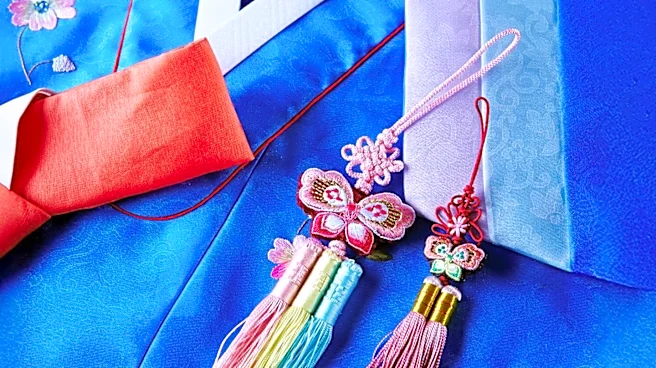




Hanbok, the traditional clothing of the Korean people, holds a rich history deeply intertwined with the nomadic cultures of the Eurasian Steppes. The term itself, meaning "Korean clothing" in South Korea, is known as *chosŏnot* in North Korea. This attire, worn by Koreans both within the peninsula and across the diaspora, including the Koryo-saram in the former Soviet Union, has a fundamental composition of a *jeogori* (top), *baji* (trousers), *chima*
(skirt), and *po* (coat). While these core elements have remained consistent, their length, width, and shape have evolved significantly over centuries.
Nomadic Origins and Early Influences
A prevailing theory suggests that the hanbok of antiquity originated from the nomadic clothing of the Eurasian Steppes, specifically Iranian Scythian clothing. This influence is believed to have spread across Siberia, from western Asia to Northeast Asia, connected by the Steppe Route. This nomadic heritage is reflected in the structural similarities between ancient hanbok and *hobok*-type clothing of other nomadic cultures in East Asia. These designs were practical, facilitating horse-riding and ease of movement, notably through the use of trousers and jackets for men and a left closure in the jacket.
The earliest visual representations of hanbok can be found in the art of the Three Kingdoms of Korea period, spanning from 57 BCE to 668 CE. Specifically, Goguryeo tomb murals from the 4th to 6th century CE offer a glimpse into these early forms. These murals depict both men and women wearing trousers, long jackets, and a sash-like belt called a *twii*. Women often wore skirts over their trousers. These fundamental structural features of hanbok have largely endured, with changes primarily occurring in the length and the method of closing the *jeogori*.
Evolution of the Jeogori and Other Garments
In early Goguryeo, the *jeogori* jackets were hip-length, resembling Persian-styled Kaftan tunics, and were belted at the waist. The *po* overcoats were full body-length Kaftan robes, also belted at the waist. The trousers of this period were roomy, showing resemblances to those found at the Xiongnu burial site of Noin Ula. Some Goguryeo aristocrats wore roomy pants with tighter bindings at the ankle, which might have indicated status, alongside factors like length, material, and color. Women sometimes wore pants or pleated skirts, and occasionally wore pants underneath their skirts.
Initially, the *jeogori* opening was closed at the center front, similar to a kaftan, or to the left. Over time, closing to the right side became the mainstream practice, becoming standard by the sixth century CE. The length of the female *jeogori* also varied; for instance, women's *jeogori* in late 5th-century Goguryeo paintings are depicted as shorter than those worn by men. The Goguryeo *jeogori* was characterized by its hip-length, narrow sleeves, a straight, crossed collar, and a belt closure at the waist. The collar and cuffs were frequently adorned with contrasting colored trim.
Headwear and Footwear in Ancient Korea
During the Goguryeo period, conical hats and similar variants were common headgear, sometimes decorated with long bird feathers. These bird feather ornaments, along with bird and tree motifs on golden crowns, are thought to symbolize connections to the sky. For footwear, two types of *hwa* (shoes) were in use: one covering only the foot, and another extending up to the lower knee. These details from ancient Goguryeo provide a comprehensive picture of the early hanbok, highlighting its practical design and symbolic elements that laid the groundwork for the traditional Korean attire seen today.