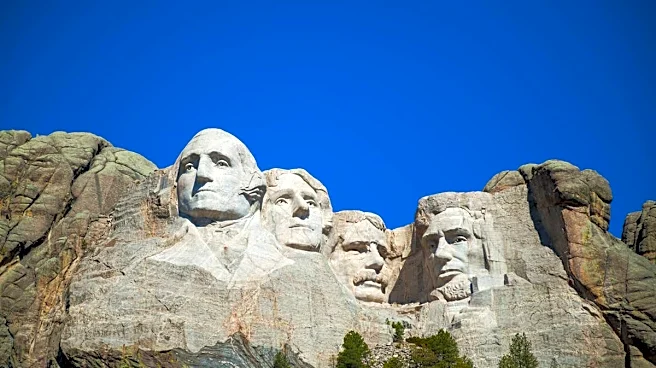



Mount Rushmore, a colossal granite sculpture nestled in the Black Hills of South Dakota, stands as a monumental tribute to American history. Its creation was a complex undertaking, born from a local tourism initiative and brought to life through the vision and perseverance of sculptor Gutzon Borglum. From its initial conception in the early 1920s to its eventual completion in 1941, the memorial evolved from a regional attraction into a national symbol,
attracting millions of visitors annually and embodying a significant chapter in the nation's story.
From Local Idea to National Project
The genesis of Mount Rushmore can be traced back to 1923, when historian Doane Robinson first proposed the idea to boost local tourism in the Black Hills region of South Dakota. Recognizing the potential for a grand sculptural project, Robinson successfully persuaded sculptor Gutzon Borglum to visit the area in 1924 to assess the feasibility of such an endeavor. Borglum, who had previously worked on a large bas-relief memorial for Confederate leaders on Stone Mountain in Georgia, brought considerable experience to the table.
Initially, the plan involved sculpting the granite formations known as the Needles within the Black Hills. However, Borglum quickly determined that the eroded rock of the Needles was too friable and unsuitable for the intricate details and scale required for the sculpture. His search led him to Mount Rushmore, a site he favored for its impressive height and excellent exposure to the sun. Upon seeing it, Borglum famously declared, "America will parade along this skyline," envisioning the mountain as a canvas for a grand historical narrative.
Securing Approval and Beginning the Carving
Bringing Borglum's vision to fruition required significant political support and funding. After extensive negotiations with President Calvin Coolidge and a delegation from Congress, the project received official approval. On March 3, 1925, a national commission for the Mount Rushmore memorial was authorized, marking a crucial step forward. President Coolidge himself played a role in shaping the monument's content, insisting that two Republicans and one Democrat be sculpted alongside President Washington.
With federal backing secured, construction officially commenced on October 4, 1927. Over the next 14 years, Gutzon Borglum, along with a team of 400 workers, embarked on the monumental task of carving the faces of four U.S. presidents into the granite. These presidents—George Washington, Thomas Jefferson, Theodore Roosevelt, and Abraham Lincoln—were chosen by Borglum to commemorate the first 150 years of United States history and to represent their respective roles in the nation's safeguarding and expansion.
The Evolution of the Sculptural Process
The carving process was a continuous effort, with faces being completed sequentially. George Washington's face was the first to be finished, inaugurated on July 4, 1934. The creation of Thomas Jefferson's portrait proved to be particularly challenging. Borglum's initial attempt, located to the right of Washington, encountered a defect in the granite. This necessitated the dramatic removal of the first attempt using explosives in 1934. A second, successful portrait of Jefferson was then carved to the left of Washington and inaugurated in 1936.
Abraham Lincoln's face was inaugurated on September 17, 1937, followed by Theodore Roosevelt's in 1939. Throughout this period, the National Park Service took the memorial under its jurisdiction in 1933, contributing to the project by improving infrastructure, such as a railway, to facilitate worker access to the mountain's summit. The sculptor's studio, which now houses an exhibition of plaster molds and tools used during the carving, was constructed in 1939 under Borglum's direct supervision, further cementing his legacy at the site.