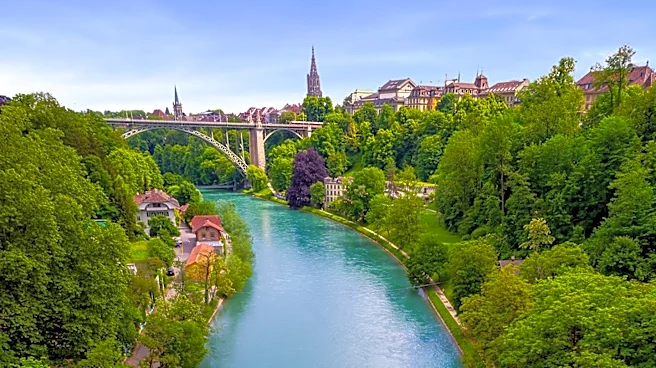






Bern, the capital of Switzerland and the Canton of Bern, has a rich history marked by continuous evolution from its medieval origins to its current status as a modern administrative center. Founded in 1191 by Duke Berchtold V of Zähringen, the city's strategic location on a peninsula surrounded by the Aare River provided natural defenses, influencing its compact and linear development. Over centuries, Bern expanded its physical boundaries, adapted
its governance, and integrated new infrastructure, all while striving to preserve its distinctive medieval character. This journey reflects a dynamic interplay between historical preservation and the demands of progress.
Early Foundations and Strategic Growth
Bern's initial settlement was strategically placed on a hilly peninsula, making it inherently defensible. The city's early layout, likely originating from Nydegg Castle and extending to the Zytglogge (clock tower), featured three main streets. This design was typical of Zähringer cities and laid the groundwork for future expansions. As the city grew, additional streets like Brunngasse and Herrengasse were added in the early thirteenth century, and a wooden bridge over the Aare facilitated trade and settlement on the east bank, indicating the city's burgeoning importance.
By the late thirteenth century, Bern expanded into the area previously occupied by Nydegg Castle, and a new west city wall was constructed to protect the growing "New City" or "Savoy City" outside the Zytglogge. This wall included the Käftigturm, or Prison Tower, marking a new western boundary. The city's defensive capabilities were further enhanced between 1622 and 1634 with the addition of the Grosse Schanze and Kleine Schanze (large and small redoubts) and the Schanzegraben (redoubt ditch or moat) outside the Christoffelturm, though these were primarily defensive and not for residential use.
Administrative and Physical Transformations
Bern's administrative structure also evolved significantly. Historically, the Old City was divided into four official administrative districts, or Viertel, for tax and defense purposes, which ceased to be used after the fall of the Ancien Régime in 1798. However, four traditional neighborhoods, or Quartiere, based on social and economic rank, emerged in the late Middle Ages and remain identifiable today. These internal divisions reflect the city's organized growth and social stratification over time.
A major turning point in Bern's physical development occurred after a devastating fire in 1405. The city, largely built of wood, was mostly destroyed. This catastrophe led to a comprehensive rebuilding effort using stone, which established the enduring architectural style and the famous arcades that characterize the Old City today. These arcades, added as houses expanded into the street, became a defining feature, ensuring that despite modifications over centuries, the essential elements of stone construction and covered walkways persisted.
Becoming a Federal Capital and Modernization Challenges
Following the Sonderbundskrieg (Separate Alliance War) in 1847, Switzerland established a federal constitution, and Bern was chosen as the capital of the new Federal State. This decision, though met with some local apprehension due to cost concerns, solidified Bern's national importance. The construction of the first Bundesrathaus (Parliament House) between 1852 and 1857, followed by the mirror-image Bundeshaus Ost and the domed Parliament Building, transformed the Old City's skyline and cemented its role as a political center.
As Bern grew, it faced the challenge of integrating modern infrastructure and traffic into its medieval core. By the early nineteenth century, the city had expanded to its limits within the old walls, leading to the growth of surrounding communities. One significant project was the demolition of the Christoffelturm and city wall in 1864 to create a large road interchange, a major bus station, and the central train station. This decision, though controversial, allowed for necessary urban development. Despite these changes, the city has largely succeeded in preserving the outer appearance of its historic buildings, ensuring that its medieval heritage remains a prominent feature even as it functions as a vibrant, modern capital.