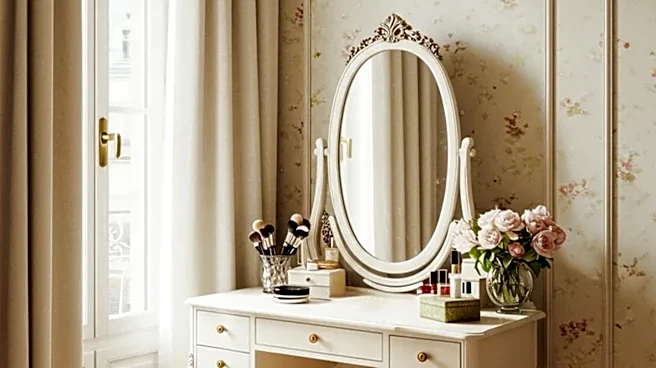




The dressing table, also known as a vanity table or simply a vanity, is a piece of furniture specifically designed for personal grooming activities such as dressing, applying makeup, and other toiletry routines. Intended for placement in a bedroom or boudoir, this functional item has a rich history that traces back centuries, evolving in form, terminology, and cultural significance. From ancient cosmetic storage boxes to elaborate pieces found in royal
collections, the dressing table reflects changing societal attitudes towards self-adornment and personal space.
Ancient Roots and Renaissance Revival
The origins of the vanity can be traced to ancient cosmetic storage boxes. For instance, a storage container for ointments, face paints, and perfumes was discovered in the tomb of an Egyptian scribe named Reniseneb, dating back to the 15th century BC. This early example highlights the long-standing human practice of using specialized containers for grooming essentials. The concept of self-adornment saw a renewed interest during the Renaissance period, which in turn created a demand for small cases, known as étuis, and the tabletops upon which to place them. This period marked a gradual shift towards more dedicated spaces and furniture for personal care.By the late 17th century, the dressing table began to take on its more familiar shape. This evolution indicates a growing recognition of the need for a distinct piece of furniture to facilitate personal grooming rituals. The design became more refined, moving beyond simple tabletops to incorporate features that would become characteristic of the dressing table. This era laid the groundwork for the more elaborate designs that would emerge in subsequent centuries.
The Mirror's Central Role and Design Evolution
A pivotal development in the history of the dressing table occurred in the mid-18th century when the mirror became an essential, integrated component. Initially, mirrors were either mounted in rotating frames or ingeniously designed to fold directly into the table itself, offering both functionality and discretion. This integration transformed the dressing table into a more complete grooming station, allowing individuals to view themselves directly as they performed their toilette.Throughout the centuries, dressing tables have been crafted in various styles and by notable designers. Examples include the dressing table of Marie-Caroline, created around 1819 and now housed in the Louvre, which showcases the elegance and craftsmanship of the era. Later, designers like Gaudi produced their own interpretations in 1889, reflecting the artistic movements of their time. Even men's dressing tables emerged, such as one by Carlo Bugatti from approximately 1904, indicating that personal grooming furniture was not exclusively for women.
Shifting Terminology in the United States and Beyond
The terminology associated with this piece of furniture has undergone significant changes, particularly in the United States. In the 18th century, it was commonly referred to as a "toilet table" or simply a "toilet," occasionally even "toiletta." However, as the American English word "toilet" evolved in the 19th century to primarily describe a toilet bowl and became associated with vulgarity, the term "dressing table" rapidly replaced it in the U.S. This term had been in use earlier but gained widespread adoption due to the linguistic shift.In contrast, the British, who used "lavatory" for the plumbing fixture, were able to maintain the neutrality of the word "toilet" and retained the "toilet terminology" for a longer period. The word "toilette" itself originates from a French diminutive form of "toile," meaning a cloth. From Medieval times, a cloth was often spread on top of a table before cosmetics were used. For a period in the 18th century, American English even saw a spelling variant, "twilight table." In the U.S., a "lowboy" is a specific type of dressing table featuring multiple drawers, often designed to complement a taller chest known as a "tallboy." These terminological shifts highlight the dynamic nature of language and its impact on everyday objects.